
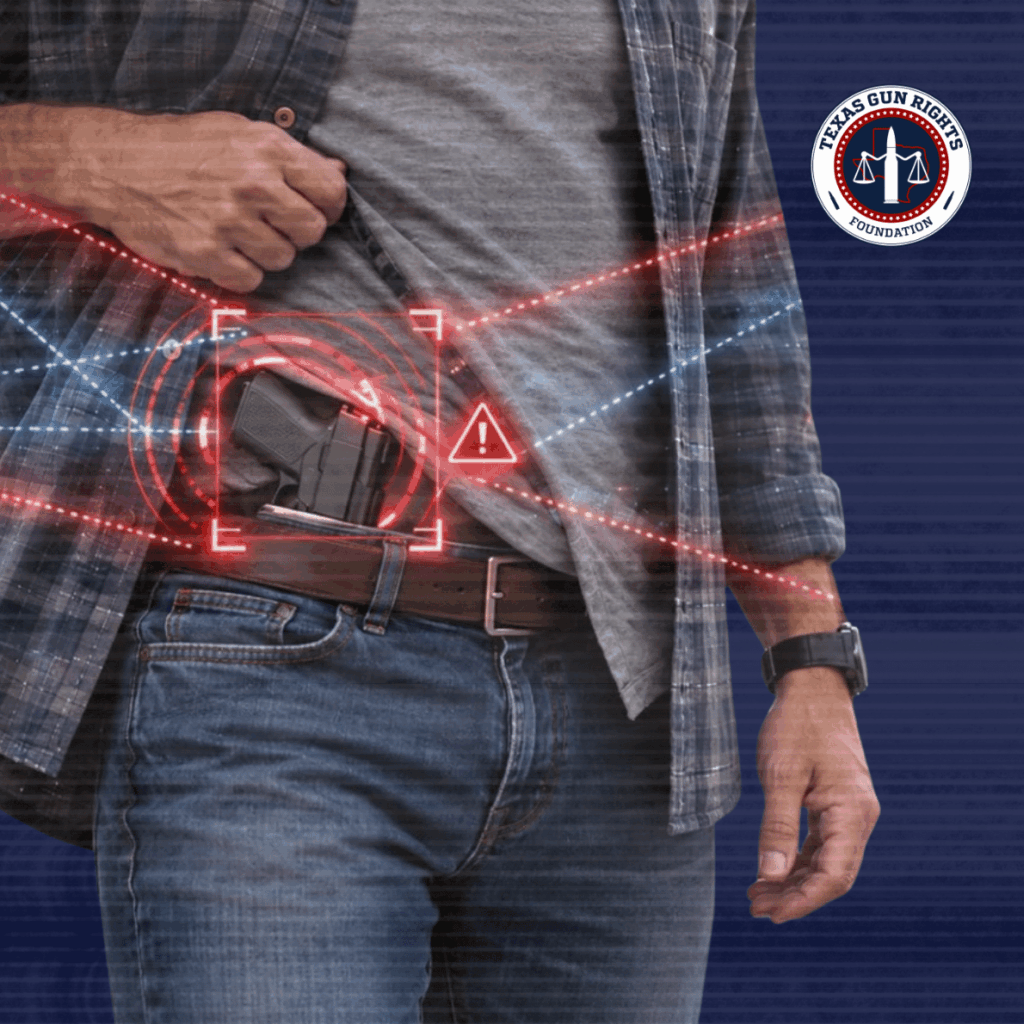
Researchers are developing technology that could identify concealed firearms without a physical search, raising questions about government surveillance, false alarms, and the safety of law-abiding gun owners.
Imagine lawfully carrying a concealed handgun into a public building, unaware that a hidden surveillance system is scanning your body for firearms.
Within seconds, an automated system could flag you as armed, potentially alerting security personnel or law enforcement, even though you haven’t threatened anyone or committed a crime.
That possibility is becoming increasingly realistic.
Researchers at Sweden’s Defence Research Agency (FOI) have developed an artificial intelligence system capable of identifying concealed handguns by analyzing how Wi-Fi signals interact with objects carried on a person’s body.
The experimental technology, called WiFireNet, requires neither a traditional metal detector nor a visible firearm to generate a detection.
As AmmoLand reported on October 20, the development raises troubling questions about the future of concealed carry, government surveillance, and the constitutional protections afforded to law-abiding Americans.
But the implications go beyond privacy.
An inaccurate detection could potentially turn an innocent encounter into a dangerous confrontation with armed security or police.
Wi-Fi Surveillance Could Expose Law-Abiding Gun Owners
The researchers trained their system to identify concealed handguns by measuring changes in wireless signals caused by objects carried on the human body.
Using artificial intelligence, the system attempts to distinguish firearms from ordinary objects, including cellphones, metal water bottles, and plastic replica guns.
According to the research paper, Concealed Handgun Detection using WiFi Signals, the technology achieved approximately 72.5% average precision for handgun detection under one evaluation threshold.
Under stricter requirements for locating the weapon, that figure dropped to 53.8%.
Those figures are technical detection metrics, not the percentage of people accurately screened. The system remains experimental, and its performance in unfamiliar environments has not been established.
Nevertheless, the implications are significant.
Traditional security screening generally involves visible checkpoints, metal detectors, or physical inspections. Wi-Fi-based systems could eventually enable screening without requiring individuals to knowingly pass through a designated checkpoint.
That creates obvious privacy concerns for Americans who lawfully carry concealed firearms.
A person exercising a constitutional right could have information about what they are carrying collected without their knowledge.
If future systems retain those detections, connect them to identities, or share them with law enforcement, the technology could potentially create records of lawful concealed carry activity.
And because wireless signals can operate without visible cameras or scanners, individuals might have no practical way of knowing when they are being screened.
The Fourth Amendment protects Americans against unreasonable government searches and seizures. Whether particular Wi-Fi firearm-detection practices constitute a search would depend on how the technology operates, where it is deployed, and what information it reveals.
The central constitutional question is whether government officials should be able to use invisible surveillance technology to investigate lawful concealed carry without individualized suspicion.
That question deserves serious scrutiny before such systems become commonplace.
False Alarms Could Put Innocent People in Danger
Privacy isn’t the only concern.
The technology could also create substantial safety risks if an automated detection is treated as evidence of an immediate threat.
The distinction between possessing a firearm and threatening someone with one is fundamental.
Millions of Americans lawfully carry concealed handguns for personal protection.
Simply identifying a firearm does not establish criminal activity, dangerous behavior, or an intention to harm anyone.
Yet a security system designed to identify firearms could produce an alert without determining whether the person carrying the weapon presents any threat.
That creates the possibility of dangerous misunderstandings.
Consider what could happen if an automated system incorrectly identifies a cellphone, water bottle, or another harmless object as a handgun.
Security personnel responding to the alert might approach the individual believing they are confronting an armed threat.
If the alert is transmitted to law enforcement, responding officers might have incomplete or inaccurate information about what is happening.
The consequences could be serious.
Such concerns are not entirely hypothetical.
In October 2025, a Maryland high school student was reportedly handcuffed after an AI-powered school security system mistakenly identified a bag of chips as a possible firearm.
That incident involved camera-based detection technology, not the experimental Wi-Fi system developed in Sweden. Nevertheless, it demonstrates the potential consequences when automated firearm alerts are acted upon before they are independently verified.
With WiFireNet’s reported detection limitations, false alarms and missed detections remain important concerns requiring further study.
An effective security system must do more than identify a possible firearm.
It must distinguish credible threats from lawful conduct and avoid creating unnecessary danger for innocent people.
A false alarm involving an armed police response is not merely a technical inconvenience. It could become a matter of life and death.
Concealed Carry, Personal Safety, and Constitutional Rights
There is another consequence that deserves attention.
Many Americans carry concealed firearms specifically because they want to protect themselves and their families without drawing unnecessary attention.
Concealment serves a practical purpose.
It allows lawful gun owners to exercise their rights discreetly while avoiding unwanted confrontations and unnecessary disclosure of their personal security decisions.
Technology capable of revealing concealed firearms could undermine that privacy.
If information identifying armed individuals were improperly accessed, disclosed, or exploited, it could potentially expose gun owners to harassment, targeting, or other safety risks.
Such risks would depend on how a system is implemented and whether its data is retained, transmitted, or secured.
There are also legitimate questions about whether pervasive detection could discourage lawful concealed carry or cause individuals to leave their firearms behind because they fear being misidentified as a threat.
That creates a potential conflict between the stated goal of improving public safety and the ability of individuals to provide for their own protection.
None of this means that every use of firearm-detection technology violates constitutional rights. Private property rules, government surveillance restrictions, and laws governing firearm possession vary by location and circumstance.
Nor does the research establish that WiFireNet is currently being used to monitor American gun owners. The published work describes an experimental system, not an operational nationwide surveillance network.
But the technology demonstrates why those legal questions cannot simply be ignored.
For the Texas Gun Rights Foundation, the emerging intersection of artificial intelligence, wireless surveillance, and lawful firearm ownership presents important subjects for constitutional research and public education.
The Second Amendment protects the individual right to keep and bear arms, while the Fourth Amendment places limits on government searches and seizures.
As surveillance technologies become more capable, understanding how those protections interact will become increasingly important.
The development of Wi-Fi gun detection should prompt careful examination of privacy safeguards, data retention, security practices, false-positive risks, and the legal standards governing law enforcement responses.
A concealed firearm is not evidence of a crime, and a computer-generated alert is not proof that someone poses a threat.
Americans should not have to choose between exercising their Second Amendment rights, protecting their personal privacy, and avoiding dangerous encounters triggered by unreliable technology.
Chip-in today to help the Texas Gun Rights Foundation research emerging firearm-surveillance technologies, expose their potential threats to privacy and personal safety, and educate Texans about their Second and Fourth Amendment rights.