Michigan U.S. Senate candidate Abdul El-Sayed has revived one of the gun-control movement’s most familiar arguments: that the Second Amendment was written when Americans had muskets, so its protections should be understood through the firearms technology of the 1700s.
But there’s a major historical problem with that argument.
When ordinary Americans had muskets, so did the government.
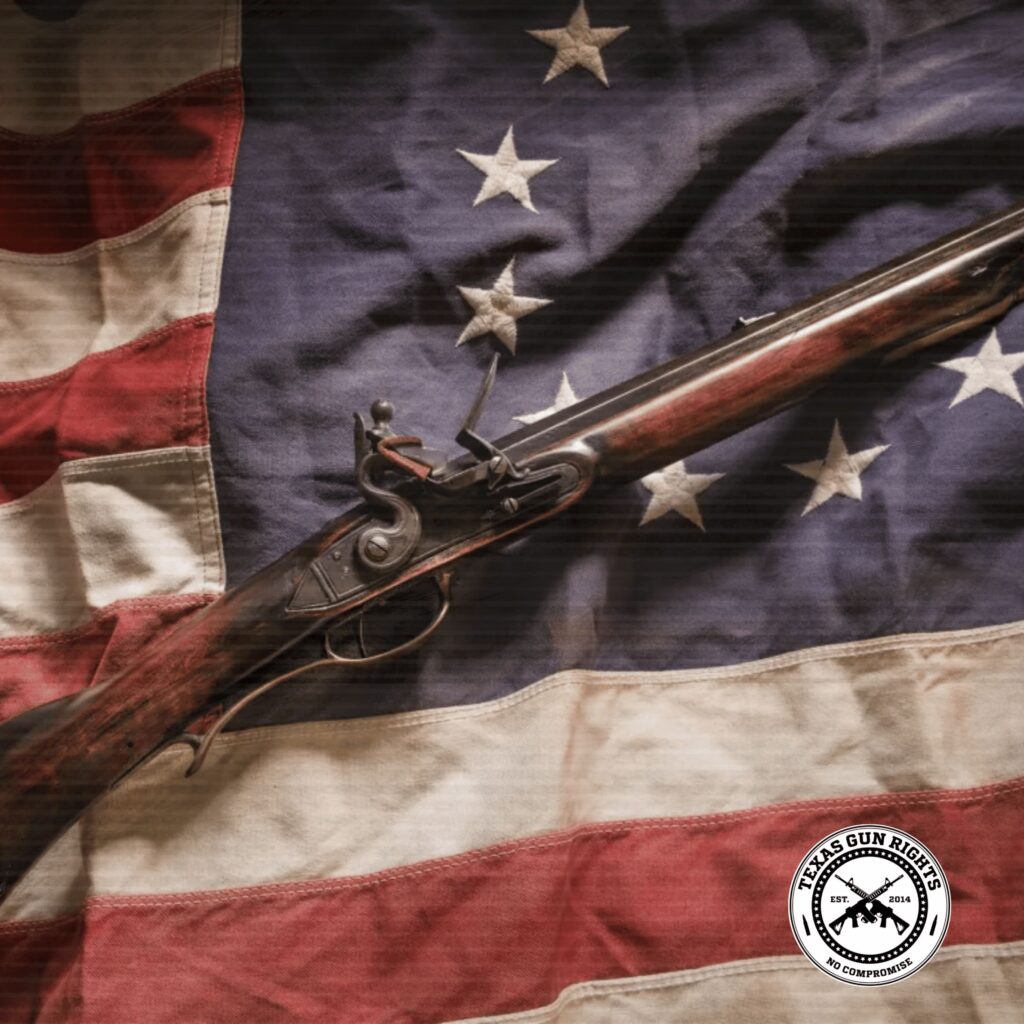
Muskets weren’t obsolete antiques when the Second Amendment was ratified. They were standard military firearms used by the armies of the day.
And the Founders didn’t merely tolerate private ownership of those weapons. Early federal law actually required eligible militiamen to furnish their own military-capable firearms and ammunition.
For Texas Gun Rights, that history underscores a fundamental constitutional principle: The Second Amendment was never intended to leave the government armed with weapons the American people were forbidden to possess.
It was written to protect an armed citizenry, including as a safeguard against government tyranny.
Yet that founding principle remains at the center of a modern political battle over firearm bans, constitutional amendments, and the future of the Supreme Court.
The Founders Expected Americans to Possess Military Arms
During an October 17 town hall in Midland, Michigan, El-Sayed attempted to use constitutional originalism to justify a narrower interpretation of the Second Amendment.
“When they promised the right to bear arms, they had muskets,” El-Sayed said, before suggesting Americans should have “equal rights to a musket.”
Video of the remarks circulated nationally and prompted criticism from gun-rights advocates.
El-Sayed went on to question whether certain modern firearms should be publicly available, particularly weapons he characterized as designed to kill large numbers of people.
But focusing on the musket itself misses the larger historical point.
In the Founders’ generation, muskets were among the principal firearms used by military infantry. They were not merely hunting implements or household curiosities. They were weapons of war, owned and carried by ordinary citizens.
The historical record is explicit.
On May 8, 1792, less than six months after the Second Amendment was ratified, Congress enacted the Militia Act of 1792.
That law required eligible, enrolled militiamen to provide their own muskets or rifles, along with ammunition and other military equipment.
Americans subject to the law were expected to arrive for militia service already armed.
The government wasn’t reserving military firearms exclusively for itself while relegating citizens to inferior weapons.
It was depending on privately armed citizens to furnish weapons suitable for military service.
James Madison made the underlying principle even clearer in Federalist No. 46.
Madison described an armed American population as an important safeguard against an oppressive federal government. He contrasted the United States with European governments that feared allowing ordinary people to possess arms.
Madison specifically identified the American people’s “advantage of being armed” as an important barrier against tyranny.
That was part of the Founders’ system of checks on concentrated government power.
The Second Amendment wasn’t simply about putting food on the table or defending against criminals, although individual self-defense remains a central constitutional protection.
It also reflected the Founders’ understanding that an armed population could serve as a final safeguard against tyranny.
Texas Gun Rights maintains that the same principle applies today: Americans must retain the right to possess arms comparable to those available to their own government, rather than being restricted to whatever outdated technology politicians decide is acceptable.
The Constitution did not establish one standard of arms for government authorities and another, permanently inferior standard for the people.
The Supreme Court Has Already Rejected the Muskets-Only Argument
El-Sayed’s argument also runs into a problem with modern Supreme Court precedent.
In District of Columbia v. Heller (2008), the Supreme Court recognized an individual right to keep and bear arms and rejected limiting the Second Amendment to weapons existing when it was ratified.
Then, in 2022, the Court reinforced the importance of historical understanding in New York State Rifle & Pistol Association v. Bruen.
Writing for the majority, Justice Clarence Thomas explained that when the Second Amendment’s plain text covers an individual’s conduct, the government bears the burden of demonstrating that its restriction is consistent with America’s historical tradition of firearm regulation.
That means modern gun laws cannot be justified merely by arguing that politicians believe those restrictions would serve a desirable public policy goal.
They must be evaluated against the Constitution’s text and the nation’s historical tradition.
And the Court specifically rejected the notion that constitutional protection stops with 18th-century weapons.
In the Bruen opinion, the justices reaffirmed that the Second Amendment’s protection extends to modern bearable arms, including weapons that did not exist at the Founding.
The principle is straightforward.
The First Amendment doesn’t stop protecting speech because Americans now communicate through smartphones instead of printing presses.
The Fourth Amendment doesn’t cease protecting privacy because the government has developed surveillance technologies the Founders could never have imagined.
And the Second Amendment doesn’t become obsolete because firearms have evolved beyond flintlocks.
To Texas Gun Rights, the history-and-tradition analysis reinforces an even more fundamental question.
If the Founders expected citizens to possess effective military arms as a check against government power, why should the federal government now possess entire categories of weapons that ordinary, peaceable Americans are forbidden to own?
Current Supreme Court doctrine recognizes limitations on certain categories of weapons, and the Court has not adopted TXGR’s full constitutional interpretation. But rejecting a muskets-only understanding is already part of established Second Amendment precedent.
For TXGR, the underlying constitutional principle remains unchanged: The government should not possess a monopoly on modern arms while denying those same arms to the American people.
From Muskets to Gun Bans: The Modern Fight Over the Second Amendment
El-Sayed’s comments are hardly occurring in isolation.
Across the country, gun-control advocates continue pushing new firearm restrictions, constitutional changes, and proposals that could reshape the judiciary responsible for interpreting the Second Amendment.
California Governor Gavin Newsom, widely discussed as a potential 2028 presidential contender, has gone so far as to propose adding a new amendment to the United States Constitution.
In 2023, Newsom proposed a 28th Amendment that would constitutionally establish several firearm restrictions, including a prohibition on civilian purchases of so-called “assault weapons,” universal background checks, mandatory waiting periods, and a minimum firearm purchase age of 21.
Newsom maintains that his proposal would leave the Second Amendment’s existing text unchanged.
But Texas Gun Rights sees a serious contradiction in that approach.
What good is leaving the words of the Second Amendment untouched if a new constitutional amendment would authorize sweeping restrictions on the very arms the Second Amendment protects?
The practical question is whether Americans would retain meaningful access to modern firearms or see entire categories placed beyond their reach.
And Texas is not immune from that debate.
As Texas Gun Rights previously reported, Democratic U.S. Senate candidate James Talarico was asked during a September interview whether a federal “assault weapons” ban remained on the table.
His answer was unequivocal:
“Absolutely.”
Talarico also said he could support legislation banning designated assault weapons or so-called large-capacity magazines, depending on the details.
Those proposals could affect widely owned semiautomatic firearms, including AR-15-style rifles.
But Talarico has also expressed openness to changes at the Supreme Court.
During a separate September interview, he said he supported a Supreme Court overhaul, including judicial ethics requirements and term limits, and was open to discussing an expansion of the number of justices.
He did not explicitly connect that proposal to overturning Second Amendment decisions.
Nevertheless, the composition of the Supreme Court matters enormously to the future of gun-rights litigation. Any proposal to expand the Court raises legitimate questions about how changes in its membership could affect constitutional protections.
To Texas Gun Rights, these developments reflect a broader struggle over whether the Second Amendment will remain a meaningful limit on government power or be steadily narrowed through legislation, constitutional changes, and judicial interpretation.
Gun-control advocates describe many of these proposals as public-safety measures intended to reduce shootings and firearm deaths.
TXGR’s position is that public safety cannot justify stripping peaceable Americans of the very constitutional protections designed to restrain government power.
And the organization rejects the premise that modern military-capable firearms should be categorically reserved for government authorities.
An armed citizenry is a check against tyranny precisely because the government does not have exclusive control over the means of armed defense.
That principle doesn’t expire because technology improves.
It doesn’t disappear because a politician dislikes a particular rifle.
And it doesn’t become irrelevant because modern firearms are more effective than the muskets used in 1791.
The Founders lived in an era when Americans could possess the same basic infantry weapons carried by government soldiers.
They understood that the balance of power between the government and the governed mattered.
Texas Gun Rights believes that balance remains just as essential today.
The Second Amendment was not written to guarantee Americans permanent access to 18th-century technology. It was written to protect the right to keep and bear arms — and to ensure that the American people would never be entirely at the mercy of an armed government.
“The Founders didn’t give Americans the right to own muskets because muskets were primitive. They protected the people’s right to bear arms because an armed citizenry is one of the final checks against government tyranny. When the government had muskets, so did the people. And Texas Gun Rights believes that same principle must apply to modern weapons today.”
Help Texas Gun Rights Defend the Second Amendment
Texas Gun Rights is fighting to preserve the original purpose of the Second Amendment through grassroots lobbying, constitutional education, and legislative accountability.
Chip in today to help TXGR expose efforts to restrict modern firearms, document politicians’ gun-control positions, and defend the constitutional principle that an armed citizenry is an essential safeguard against tyranny.