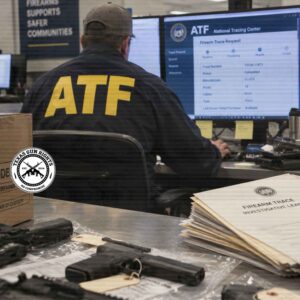
From Ruby Ridge to Waco to the prosecution of Navy sailor Patrick “Tate” Adamiak, the Bureau of Alcohol, Tobacco, Firearms and Explosives (ATF) has faced serious questions about its use of confidential informants. Now, new reporting has uncovered troubling contradictions in the government’s own records.
An October 2026 AmmoLand investigation by journalist John Crump details how the ATF relied on Gregory Pruess, a convicted felon with an extensive firearms-related criminal history, to build its case against Adamiak.
According to federal court records cited in the investigation, Pruess cooperated with the ATF to avoid criminal charges after agents discovered firearms he was prohibited from possessing.
The government also acknowledged paying him approximately $8,000.
But an earlier ATF affidavit stated that no promises or guarantees had been made to the informant.
For Texas Gun Rights (TXGR), these revelations raise serious questions about the ATF’s investigative practices and reinforce the organization’s longstanding demand to abolish the agency.
A Convicted Felon, a Secret Identity, and an $8,000 Payment
Texas Gun Rights has previously documented Adamiak’s prosecution, including his insistence that the firearms-related items at the center of the case were lawful parts, replicas, and historical collectibles.
Adamiak, a decorated Navy sailor and military memorabilia collector, was convicted on federal firearms charges and sentenced to 20 years in prison.
He maintained that the ATF had mischaracterized items in his collection and pursued charges based on disputed interpretations of federal firearms law.
Now, the latest investigation sheds additional light on the man who helped federal agents build their case.
Gregory Pruess was no ordinary customer.
His criminal history included multiple firearms-related convictions. According to the government’s own appellate filings, ATF agents discovered that Pruess unlawfully possessed two pistols and a rifle.
Rather than prosecute him for those alleged violations, agents secured his cooperation in their investigation of Adamiak.
Pruess was also paid approximately $8,000.
Federal filings describe how Pruess, acting under ATF direction, used the false identity “Rick Hayes” to communicate with Adamiak and arrange purchases of firearm parts.
The government’s account of that arrangement raises an important question: What incentives did the informant have to produce evidence against Adamiak?
There is another troubling discrepancy.
An April 2022 ATF affidavit stated that no promises or guarantees had been made to Pruess regarding his cooperation. Yet the government’s July 2024 appellate brief described his cooperation as a means of avoiding criminal charges.
Those statements are not necessarily legally irreconcilable, but they demand an explanation of precisely what was offered, understood, and disclosed.
Adding another layer to the controversy, Pruess reportedly denied assisting the ATF when contacted by AmmoLand, despite federal court records documenting his participation.
A jury convicted Adamiak, and the government’s position was that the disputed items met the relevant federal firearms definitions. The new reporting does not itself overturn those findings or establish prosecutorial misconduct.
Nevertheless, the documented incentives and conflicting accounts surrounding the informant warrant scrutiny.
In September 2026, President Donald Trump pardoned Adamiak after he had spent nearly four years in federal custody.
As Texas Gun Rights reported following his pardon, his case had become a major concern for Second Amendment advocates, including the National Association for Gun Rights, which supported his Supreme Court fight.
The pardon brought Adamiak’s imprisonment to an end.
It did not answer every question about how the ATF built its case.
From Ruby Ridge to Waco: Decades of Questions About ATF Informants
The Adamiak case is not the first time the ATF’s use of confidential informants has come under scrutiny.
At Ruby Ridge in 1992, the government’s use of an informant became part of a broader controversy surrounding federal law enforcement tactics and the deadly confrontation involving the Weaver family.
A subsequent Justice Department review identified failures to disclose the full extent of an ATF informant’s compensation arrangement.
At Waco in 1993, confidential-source activity also figured into the events preceding the disastrous federal raid on the Branch Davidian compound.
According to the ATF’s own chronology, a confidential source informed a reporter that something significant was about to happen at the compound. The agency subsequently moved the planned raid date.
Texas Gun Rights has previously examined the Waco tragedy and its implications for federal gun enforcement.
The circumstances of Ruby Ridge, Waco, and Adamiak’s prosecution differ substantially. The involvement of an informant does not, by itself, establish misconduct.
But the larger issue extends beyond individual cases.
A 2017 Justice Department inspector general review found significant weaknesses in the ATF’s confidential-informant oversight, including deficiencies involving documentation, payments, and supervision.
These are not merely complaints from gun-rights activists. They are oversight concerns documented within the federal government itself.
And for TXGR, they reinforce a fundamental objection to the concentration of investigative and enforcement power within an agency whose actions can carry devastating consequences.
The consequences of aggressive ATF enforcement are not always limited to prosecution.
In March 2024, federal agents conducting an ATF search warrant operation fatally shot Little Rock airport executive Bryan Malinowski at his Arkansas home.
Texas Gun Rights previously covered Malinowski’s death as another example of why the organization’s concerns about ATF enforcement extend far beyond administrative regulations.
The circumstances of that shooting are distinct from the informant issues in Adamiak’s case. Together, however, these controversies have fueled TXGR’s calls for greater accountability and fundamental changes to federal firearms enforcement.
Adamiak Is Free. The Questions About the ATF Remain.
Patrick Tate Adamiak received a presidential pardon, but the new reporting leaves important questions unresolved.
What precisely did the ATF promise Gregory Pruess?
What information about his criminal exposure and financial compensation was disclosed to Adamiak’s defense?
Why did the government’s later description of the informant’s cooperation differ from the earlier affidavit?
And what safeguards are in place to prevent financially compensated informants from improperly influencing firearms investigations?
These questions deserve documented answers.
“Texas Gun Rights has warned for years about the dangers of unchecked federal firearms enforcement,” said TXGR President Chris McNutt. “When the government’s own records raise questions about payments to criminal informants and the promises made to them, Americans deserve answers and accountability. Our position has not changed: the ATF should be abolished.”
Texas Gun Rights maintains that the problems surrounding the ATF cannot be addressed adequately through promises of better management or temporary changes in leadership.
Its position is that Congress should abolish the agency and pursue federal firearms policy consistent with the Second Amendment.
Adamiak’s pardon resolved his imprisonment. It did not resolve the broader questions surrounding the agency that prosecuted him.
Texas Gun Rights is calling for the ATF to be abolished.
SIGN THE PETITION: ABOLISH THE ATF NOW!
Add your name to Texas Gun Rights’ petition calling on Congress to abolish the Bureau of Alcohol, Tobacco, Firearms and Explosives.