The Bureau of Alcohol, Tobacco, Firearms and Explosives (ATF) has released a new firearm tracing factsheet, highlighting how federal agents track guns recovered during criminal investigations.
But the report also reveals an important limitation: ATF firearm traces generally identify the last known retail purchaser, not necessarily the person who currently owns or possesses the gun.
That distinction is drawing attention from Second Amendment advocates concerned about federal firearm tracking and the potential for expanding government recordkeeping.
In an October 7 Bearing Arms analysis, writer Tom Knighton questioned whether the ATF’s examples demonstrate the effectiveness of tracing as strongly as the agency suggests.
For Texas Gun Rights, the report raises an important question: Where should legitimate criminal investigations end and government tracking of lawful gun owners begin?
What the ATF’s Report Actually Says
According to the ATF’s October 2026 factsheet, the National Tracing Center processes more than 600,000 unique firearm trace requests annually.
The agency claims approximately 75% of those requests produce investigative leads that law enforcement can use to solve crimes.
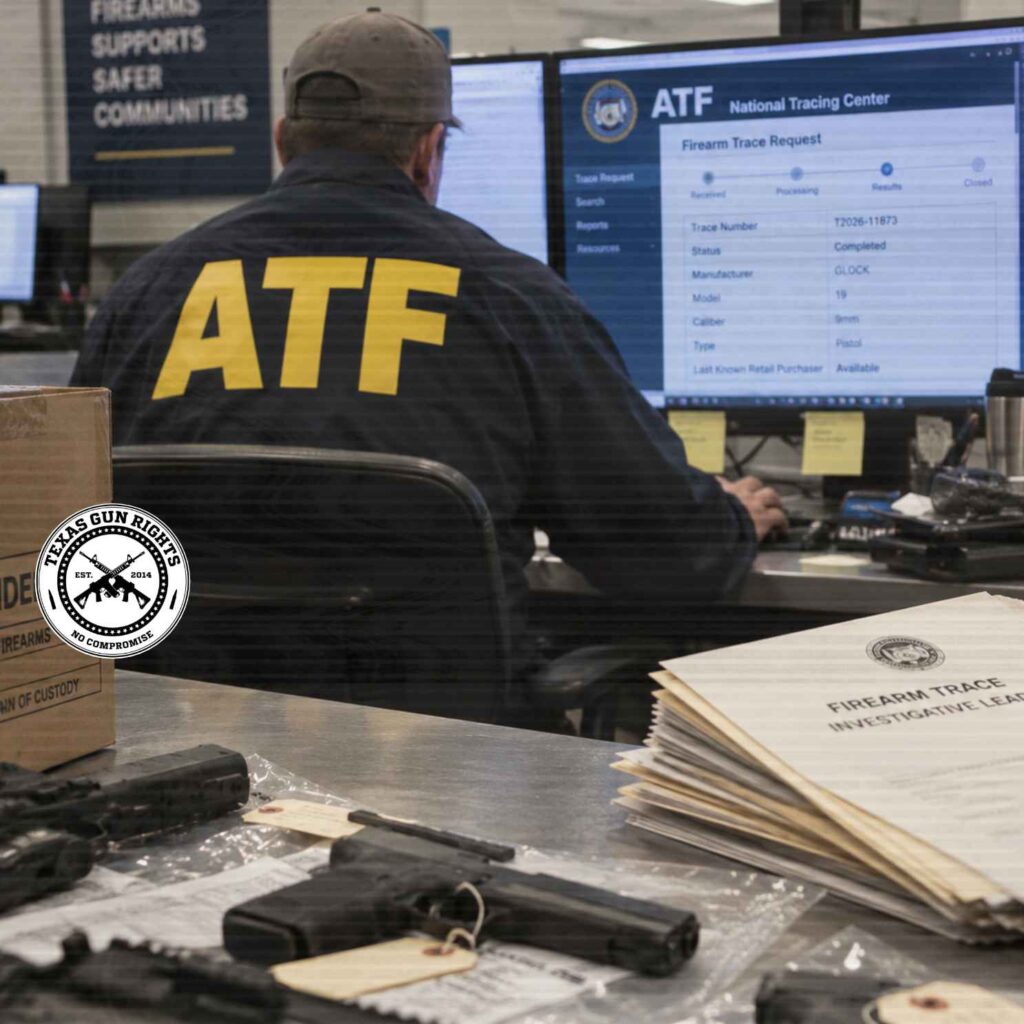
When a firearm is recovered at a crime scene, investigators can request a trace through the National Tracing Center.
Agents use firearm markings and manufacturer or importer records to trace the weapon through the commercial distribution chain to its last known retail purchaser.
But there’s a catch.
The original retail purchaser is not necessarily the current owner, the person who possessed the firearm during a crime, or the person responsible for criminal activity.
Firearms can change hands after their initial retail sale, meaning a trace may not reveal the complete ownership history.
That limitation is central to the debate over how much information the federal government should maintain about privately owned firearms.
Investigative Tool or Argument for More Government Tracking?
The ATF highlighted several investigations in which firearm tracing helped authorities identify suspects, locate purchasers, or uncover trafficking networks.
One example involved the 2022 Highland Park shooting, where tracing helped investigators identify the original firearm purchaser before authorities arrested the suspect.
Another involved a firearms trafficking investigation in Georgia, where approximately 116 firearms were traced and investigators identified a criminal organization smuggling weapons into Mexico.
These examples demonstrate that tracing can provide useful investigative information.
However, as Bearing Arms noted, tracing does not automatically establish who committed a crime, nor does identifying a retail purchaser necessarily establish current ownership.
That distinction matters when discussing proposals for broader firearm registration or tracking.
Texas Gun Rights maintains that legitimate law enforcement investigations should not become a justification for establishing a comprehensive government registry of lawful gun owners.
The ATF factsheet itself does not propose creating such a registry.
TXGR: Protect Gun Owners’ Privacy and Constitutional Rights
Texas Gun Rights supports holding violent criminals accountable while opposing government policies that unnecessarily burden lawful firearm ownership.
The organization has consistently maintained that the Second Amendment protects an individual constitutional right, not a privilege dependent on federal permission or surveillance.
The ATF’s latest report highlights both the potential usefulness and the limitations of firearm tracing.
It also reinforces why gun owners should pay close attention to federal firearm recordkeeping policies and proposals that could expand government access to ownership information.
“The government can investigate criminals without treating every law-abiding gun owner like a suspect,” says TXGR President Chris McNutt.
“Firearm tracing may help investigators follow leads, but it should never become an excuse to build a national gun registry or track Texans simply because they exercise their Second Amendment rights.”
Texas Gun Rights will continue monitoring federal firearm tracking policies, ATF activities, and proposals affecting the privacy and constitutional rights of Texas gun owners.
Help TXGR Defend Gun Owners’ Rights
Texas Gun Rights works to educate Texans about federal gun policies, expose threats to Second Amendment protections, and hold government officials accountable for their actions.
Chip in to Texas Gun Rights today to help fund TXGR’s Second Amendment education, government accountability research, and grassroots advocacy programs.