ATF’s stunning announcement is welcome relief for gun owners. But buried in the fine print is a warning that could put thousands of Americans in legal jeopardy — and vindicate everything Texas Gun Rights warned about in 2025.
By Chris McNutt
The National Firearms Act is dead!
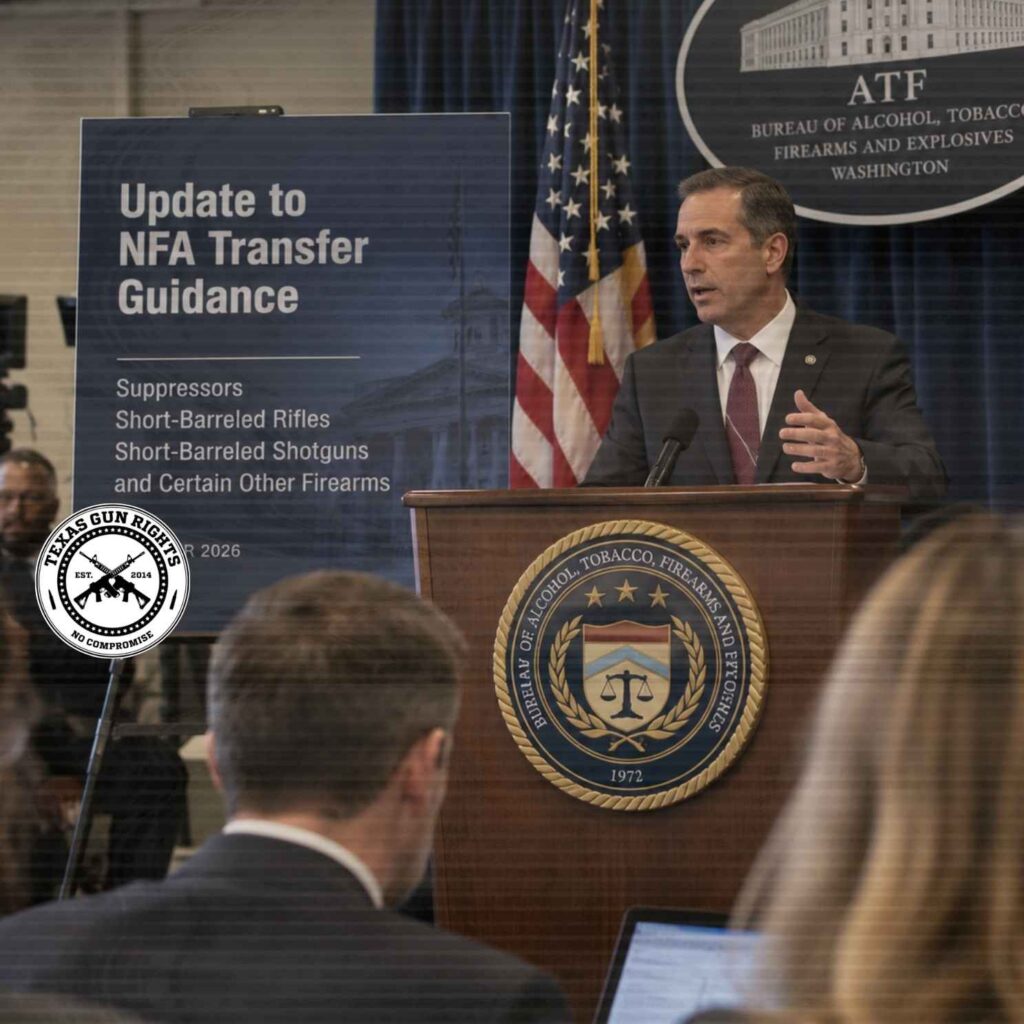
At least, that’s what gun owners across America are being told following the Bureau of Alcohol, Tobacco, Firearms and Explosives’ bombshell announcement on October 9, 2026.
According to the ATF, the federal government will no longer enforce most NFA registration, approval, and tax-stamp requirements for suppressors, short-barreled rifles, short-barreled shotguns, and certain other firearms.
No more mandatory NFA registration under the new enforcement policy. No more waiting for ATF approval before acquiring these covered firearms. No more federal tax stamps.
It’s a remarkable development, and the plaintiffs whose litigation helped bring about this change deserve credit for a major courtroom victory.
But before anyone breaks out the champagne, there’s a serious problem.
The National Firearms Act is still on the books. And the ATF is openly admitting that Americans who rely on today’s nonenforcement policy could face felony prosecution if Washington changes its mind.
That’s not exactly the permanent restoration of our Second Amendment rights.
And it’s precisely the kind of danger Texas Gun Rights warned about when congressional Republicans abandoned full NFA deregulation during the 2025 One Big Beautiful Bill fight.
We weren’t willing to settle for removing the price tag while leaving the federal government’s criminal enforcement machinery intact.
Now we’re seeing why that distinction matters.
The ATF Just Admitted the Danger
The October 9 announcement followed a federal court ruling in Texas that struck at the constitutional foundation of major NFA restrictions.
Because Congress eliminated the $200 making and transfer taxes on suppressors and certain short-barreled firearms in 2025, the court concluded that the challenged registration and approval requirements could no longer be justified under Congress’s taxing power.
The Department of Justice declined to appeal and extended its nonenforcement policy nationwide.
That’s welcome news.
But there’s an explosive admission buried in the ATF’s official guidance.
Under the section titled Future Risk, the agency acknowledges that NFA enforcement could resume if the underlying legal circumstances change or a future Justice Department rescinds the policy.
Then ATF addresses whether Americans possessing unregistered firearms would receive grandfather protection.
Its answer?
Federal law provides no automatic grandfather protection for those firearms, and generally does not allow them to be registered after the fact.
An Attorney General could authorize a temporary registration amnesty. But the government would not be required to offer one.
Consider the implications.
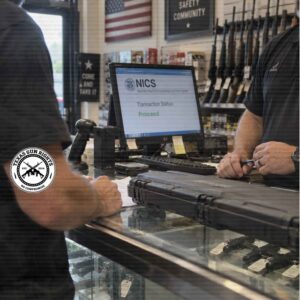
A Texas gun owner walks into a federally licensed dealer, passes the required background check, and purchases a suppressor without NFA registration under the government’s current policy.
Years later, a different administration takes office and reverses that policy.
The registration statutes are still on the books. The suppressor is still unregistered. And its owner may have no ordinary legal mechanism to bring it into compliance.
That individual could face serious criminal exposure simply for continuing to possess property acquired in reliance on the federal government’s earlier guidance.
There would be substantial constitutional questions about fair notice, due process, and reliance on official government representations. Prosecution would not be automatic, and conviction would be far from a foregone conclusion.
But those protections might have to be fought for in federal court.
Since when should exercising the Second Amendment require Americans to gamble their freedom on the next administration’s interpretation of federal law?
If large numbers of gun owners acquire unregistered firearms under this policy, the potential consequences of reversing it could be enormous.
And the government has offered no guaranteed grandfather protection.
Some have suggested that the sheer number of Americans who may acquire unregistered suppressors and short-barreled firearms under this policy could make it politically and legally difficult for a future administration to reverse course.
There’s some merit to that argument.
Federal courts have recognized that Americans can, under certain circumstances, raise due-process defenses when prosecuted for conduct they reasonably believed the government had authorized. And an administration attempting to prosecute thousands of gun owners who relied on official federal guidance could face enormous political, practical, and constitutional obstacles.
But here’s the catch.
The ATF has already warned that its policy could be reversed and that unregistered firearms have no automatic grandfather protection. That warning could complicate future claims that the government unconditionally assured gun owners their continued possession would remain lawful.
And a future administration wouldn’t have to prosecute everyone to create serious consequences for individual gun owners.
Betting that Washington will never enforce a law because too many Americans have relied on its promise not to is a dangerous substitute for permanently removing that law from the books.
Temporary nonenforcement is not permanent deregulation.
Texas Gun Rights Warned Congress This Would Happen
To understand how Washington created this problem, go back to the summer of 2025.
President Trump’s One Big Beautiful Bill presented congressional Republicans with an extraordinary opportunity to dismantle major portions of the National Firearms Act.
The House passed legislation removing suppressors from the NFA. The Senate Finance Committee subsequently included broader provisions to deregulate short-barreled rifles, short-barreled shotguns, and other covered firearms.
For once, Congress was positioned to do something far more meaningful than reduce a tax.
It could remove the underlying federal registration and approval restrictions.
Texas Gun Rights joined our national affiliate, the National Association for Gun Rights, in demanding exactly that.
Then came the Senate parliamentarian.
On June 27, 2025, the parliamentarian advised that the deregulation provisions violated the Byrd Rule governing budget reconciliation.
Senate Republican leadership accepted the procedural objection and removed the deregulation provisions rather than successfully pursuing their restoration.
The final bill eliminated the $200 tax but preserved the NFA’s registration framework and criminal provisions.
Senate Majority Leader John Thune and Texas Senator John Cornyn faced a choice about how aggressively to challenge the procedural roadblock. Cornyn had publicly supported the broader deregulation language, but ultimately accepted the narrower legislation.
Texas Gun Rights publicly challenged Cornyn and Senate leadership for backing away from the fight.
And we weren’t particularly impressed by the celebrations coming from much of the Washington gun-rights establishment.
Some organizations that had previously called for full deregulation nevertheless praised the final tax-cut legislation, portraying the compromise as an important victory while acknowledging that it fell short of their ultimate goals.
They were entitled to recognize an incremental legislative gain.
But Texas Gun Rights was not going to confuse an incremental gain with accomplishing the mission.
We weren’t fighting to make federal gun registration cheaper. We were fighting to eliminate it.
We understood that removing the tax without removing the underlying restrictions left the federal government’s statutory enforcement powers in place.
On July 8, 2025, I put it bluntly in our public criticism of the final legislation:
“They took off the price tag, but left the chains.”
That wasn’t hindsight.
That warning came more than a year before the ATF’s October 2026 announcement.
At the time, some in the gun-rights movement were ready to call the compromise a victory and move on to the next fight.
We refused.
And today, the ATF’s own guidance demonstrates why leaving those criminal statutes intact carries real consequences.
The organizations that supported the final bill did not all abandon the broader objective. Some continued calling for repeal, and several subsequently pursued major constitutional litigation.
Their courtroom work deserves recognition.
But litigation after the fact doesn’t erase the fundamental legislative failure: Congress had an opportunity to remove these firearms from the NFA and instead left their owners dependent on an unresolved legal framework.
That’s the difference between fighting for a temporary improvement and demanding a permanent solution.
And that’s why Texas Gun Rights refused to give Republican leadership a pass simply because the final compromise could be packaged as a win.
Courtroom Victories Cannot Replace Permanent Repeal
After Congress failed to deliver full deregulation, gun-rights organizations turned to the courts.
Gun Owners of America, Silencer Shop Foundation, and their fellow plaintiffs brought a major challenge to the remaining NFA restrictions. Other organizations pursued separate litigation, including a related Texas case ultimately consolidated with the original lawsuit.
On August 5, 2026, U.S. District Judge James Wesley Hendrix issued a landmark ruling in Silencer Shop Foundation v. ATF.
The court concluded that the challenged NFA requirements could no longer be sustained under Congress’s taxing authority once the relevant taxes had been eliminated.
That was a major legal victory.
But the court’s permanent injunction protects the plaintiffs and other specified parties, including covered members and customers.
The nationwide nonenforcement policy announced in October was a separate decision by the Justice Department.
And that is the critical difference.
A judicial injunction provides protection within its legal scope. A nationwide executive nonenforcement policy may be rescinded. Neither removes the underlying statutory provisions from federal law.
The district court also did not decide the Second Amendment claims, leaving additional constitutional questions unresolved.
Congressional repeal would accomplish something fundamentally different: removing the covered NFA restrictions themselves, rather than relying on continued judicial protection or executive discretion.
This is not an argument against litigation.
Courtroom victories can be enormously important, particularly when politicians refuse to act.
But they should not become a substitute for demanding legislative accountability.
Think about the years of litigation, attorney fees, organizational resources, and legal uncertainty that surround the NFA.
We cannot know how much of that litigation a different congressional outcome would have prevented. But if Congress had actually removed these firearms from the NFA in 2025, Americans would not now be relying on an administrative promise not to enforce those particular statutory restrictions.
That’s the problem Texas Gun Rights was trying to prevent.
And the solution is not to declare the fight over because the current administration happens to agree with us.
The solution is to remove the government’s power to revive these restrictions in the first place.
Texas Gun Rights supports removing suppressors, short-barreled rifles, short-barreled shotguns, and other affected firearms from the NFA, while continuing to advocate full repeal of the Act.
Congress should also address the status of firearms acquired without registration under the current federal policy, rather than leaving their owners exposed to uncertainty about future enforcement.
We have no intention of accepting another compromise that leaves the next generation of gun owners fighting the same battle all over again.
That is what no-compromise advocacy means.
Not celebrating every concession Washington offers.
Not excusing weak leadership because the politicians involved call themselves Republicans.
And not treating a government’s temporary decision to leave gun owners alone as the permanent restoration of a constitutional right.
The October 9 announcement is a major development, and the legal victory that helped produce it matters.
But Texas Gun Rights will not declare the mission accomplished while the laws threatening gun owners’ freedom remain on the books.
Chip In to Texas Gun Rights — Help Finish the Fight
The lesson of this fight is unmistakable: Gun owners need more than lawsuits and temporary promises from Washington.
They need an organized grassroots movement willing to pressure Congress, expose political excuses, and demand lasting legislative reform.
That’s what Texas Gun Rights does.
Our work centers on mobilizing gun owners, holding lawmakers accountable, and fighting for policies that remove government restrictions rather than merely make them more tolerable.
We warned about the dangers of the 2025 compromise when celebrating it would have been the easier choice.
And we’re not backing down now.
Your contribution helps Texas Gun Rights fund the grassroots lobbying, legislative research, public education, and lawmaker accountability campaigns necessary to keep the fight for NFA repeal moving forward.
We don’t need another generation of Americans trapped in an endless cycle of litigation and temporary regulatory relief.
We need Congress to finish the job.
CHIP IN TO TEXAS GUN RIGHTS — HELP FIGHT FOR FULL NFA REPEAL
No compromise. No excuses. No surrender.