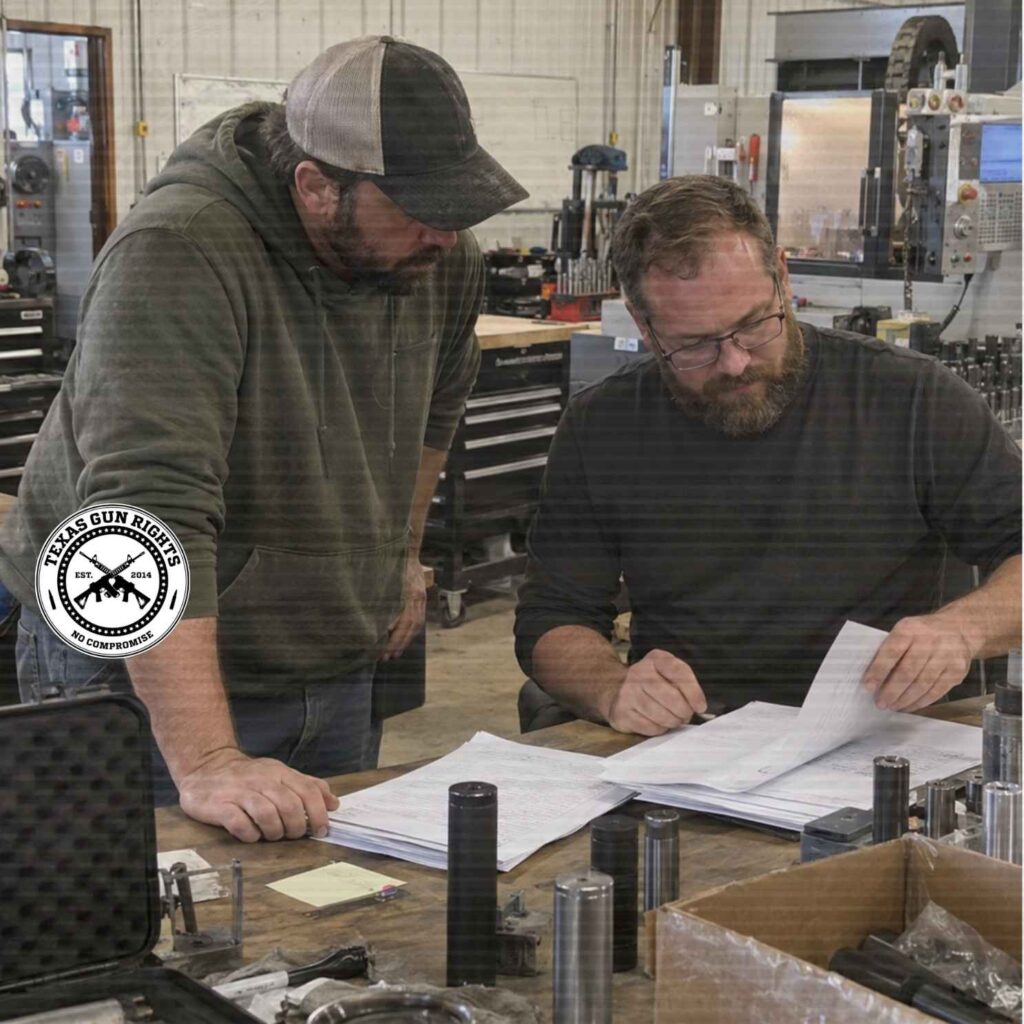
After nearly two years of federal investigations and property seizures, Texas suppressor manufacturers Jared Gee and David Abt are taking the fight directly to Washington — challenging whether Congress has the constitutional authority to license a business operating entirely within Texas.
Two Texas Gun Rights members whose suppressor business was targeted in a sweeping federal ATF investigation have filed a new constitutional lawsuit against the Department of Justice, challenging the federal government’s authority to regulate firearm suppressors manufactured and sold entirely within Texas.
Jared Gee and David Abt, owners of Texas-based suppressor manufacturer 1836 LLC, filed their lawsuit on October 9 in the U.S. District Court for the Northern District of Texas.
The case, 1836 LLC v. Bureau of Alcohol, Tobacco, Firearms and Explosives, Case No. 3:26-cv-03535, has been assigned to U.S. District Judge Brantley Starr.
Unlike recent litigation challenging the National Firearms Act’s taxation and registration requirements, this lawsuit goes after a separate federal gun-control law: the Gun Control Act of 1968 and its requirement that commercial firearms manufacturers obtain federal licenses.
At the center of the case is a straightforward constitutional question:
If a suppressor is manufactured in Texas, sold to a Texan, and never leaves Texas, what constitutional authority does Congress have to require the manufacturer to obtain a federal license?
Gee and Abt argue that Congress exceeded its authority under the Constitution’s Commerce Clause by imposing federal licensing requirements on their exclusively intrastate business.
The lawsuit was filed on October 9, 2026, naming the ATF, DOJ, and federal officials as defendants.
For Texas Gun Rights, the case represents another major chapter in a federal enforcement dispute involving two of our own members — and a potentially consequential challenge to Washington’s authority over Texas firearms businesses.
From ATF Raids to a Constitutional Showdown
The dispute began in August 2024, when federal ATF agents descended on 1836 LLC’s display at the Texas Trophy Hunters Extravaganza in Fort Worth.
According to the company’s owners, agents seized suppressors, display firearms, inventory, and electronic equipment.
Additional federal searches followed at the owners’ businesses and homes.
As Texas Gun Rights reported in February 2026, the investigation left Gee and Abt facing prolonged legal uncertainty, seized property, and the possibility of federal criminal charges despite no indictment having been filed at that time.
Their business had operated under the premise established by Texas House Bill 957, legislation enacted in 2021 that asserted the state’s authority over suppressors manufactured and retained entirely within Texas.
That law, now codified in Texas Government Code § 2.052, declares that qualifying Texas-made suppressors are not subject to federal regulation under Congress’s interstate-commerce authority.
Federal authorities, however, have maintained that federal firearms laws remain applicable notwithstanding the Texas statute.
The resulting conflict placed Gee and Abt directly in the middle of a constitutional dispute over the limits of federal power.
According to 1836 LLC, its earlier federal case was subsequently dismissed following Congress’s elimination of the NFA making and transfer taxes and an August 2026 federal court ruling against major NFA restrictions.
Now the company is pursuing a new challenge focused specifically on federal manufacturing licenses.
The owners argue that obtaining a federal firearms license would subject their small business to extensive federal paperwork, recordkeeping, and compliance obligations, even though they do not intend to manufacture or sell suppressors across state lines.
They estimate those administrative burdens could consume as much as one-third of their working time.
But their objection goes beyond paperwork.
Their argument is that Congress cannot use its authority over interstate commerce to impose federal licensing requirements on a suppressor business whose manufacturing and sales remain entirely within Texas.
The NFA Ruling Opened a New Constitutional Fight
The timing of the lawsuit is significant.
On August 5, 2026, U.S. District Judge James Wesley Hendrix ruled in Silencer Shop Foundation v. ATF that major provisions of the National Firearms Act could no longer be sustained under Congress’s taxing power after Congress eliminated the relevant making and transfer taxes.
Then, on October 9, the Justice Department announced it would not appeal that ruling and would extend its nonenforcement policy nationwide.
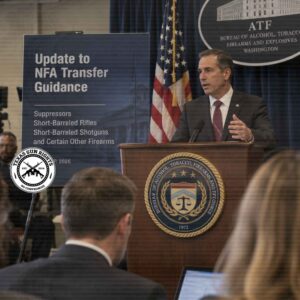
Under the ATF’s newly announced guidance, federal authorities will no longer enforce several NFA registration and approval requirements involving suppressors, short-barreled rifles, short-barreled shotguns, and certain other firearms.
But the announcement also exposed a critical distinction between two federal gun-control laws.
The NFA’s challenged registration and approval system rested on Congress’s taxing authority.
The Gun Control Act of 1968 establishes a separate federal licensing system grounded in Congress’s authority to regulate interstate commerce.
The latter remains enforceable.
Under 18 U.S.C. § 923, individuals and businesses engaged in commercial firearms manufacturing generally must obtain a federal license.
The ATF’s new guidance also confirms that businesses manufacturing NFA firearms remain subject to applicable Special Occupational Taxes, separate from the making and transfer taxes Congress eliminated.
The new lawsuit focuses on the federal manufacturing-license requirement, not on a refusal to pay the separate occupational tax.
For 1836 LLC, that distinction is central.
The owners argue that federal taxation and licensing authority have historically operated together to regulate suppressor manufacturing, but the recent changes to the NFA expose a constitutional question that remains unanswered.
If Congress’s taxing power can no longer sustain the challenged NFA registration requirements, the plaintiffs contend that the government must independently justify imposing the Gun Control Act’s licensing system on their Texas-only operations.
The challenge will face substantial legal obstacles.
In Gonzales v. Raich, the U.S. Supreme Court recognized broad congressional authority to regulate certain intrastate economic activity when doing so is part of a larger interstate regulatory framework.
Federal attorneys could rely on that precedent in defending the licensing requirement.
But Gee and Abt are asking the court to draw a constitutional boundary between commerce among the states and manufacturing and sales occurring exclusively within one state.
A favorable ruling could establish meaningful limits on how federal manufacturing-license requirements may be applied to their business, potentially opening the door to additional challenges involving similar Texas operations.
Whether the court will accept that distinction remains unresolved.
Texas Gun Rights: Federal Power Must Have Constitutional Limits
For Texas Gun Rights, the constitutional issues surrounding 1836 LLC are closely connected to our longstanding fight against federal overreach.
Texas lawmakers enacted HB 957 to assert that suppressors manufactured and retained within our state’s borders should not automatically fall under federal control.
But the experiences of Gee and Abt demonstrate the enormous consequences Texans can face when state law and federal enforcement collide.
Two small-business owners have spent more than two years confronting federal investigations, property seizures, and legal uncertainty over the scope of federal firearms regulation.
Now they’re asking a federal judge to determine whether Washington had the constitutional authority to impose the challenged licensing requirements in the first place.
But the lawsuit raises an issue that extends beyond a single suppressor manufacturer.
Where does the federal government’s authority end, and where does Texas’s authority over commerce within its own borders begin?
That question deserves an answer.
The recent NFA victory demonstrated how constitutional litigation can challenge federal restrictions that have been accepted for decades.
The new 1836 LLC lawsuit seeks to test a different part of that same regulatory structure.
And it serves as another reminder that eliminating the NFA’s taxes and registration requirements does not automatically eliminate the independent restrictions contained in the Gun Control Act.
For Texas Gun Rights, the ultimate objective remains the same: permanent legislative reform that removes federal infringements on the right to keep and bear arms, rather than leaving gun owners dependent on shifting enforcement policies and years of litigation.
Help Texas Gun Rights Continue the Fight
Texas Gun Rights has followed the ordeal involving Jared Gee, David Abt, and 1836 LLC from the beginning because protecting the rights of Texas gun owners means standing up when federal agencies threaten those rights.
Our work doesn’t stop with one court ruling or one regulatory announcement.
Your contribution helps fund the Second Amendment education, legislative research, grassroots lobbying, and government-accountability efforts needed to challenge federal overreach and demand permanent reform.
CHIP IN TO TEXAS GUN RIGHTS — HELP DEFEND THE SECOND AMENDMENT
Texas Gun Rights will continue monitoring 1836 LLC’s constitutional challenge and reporting significant developments as the case proceeds.