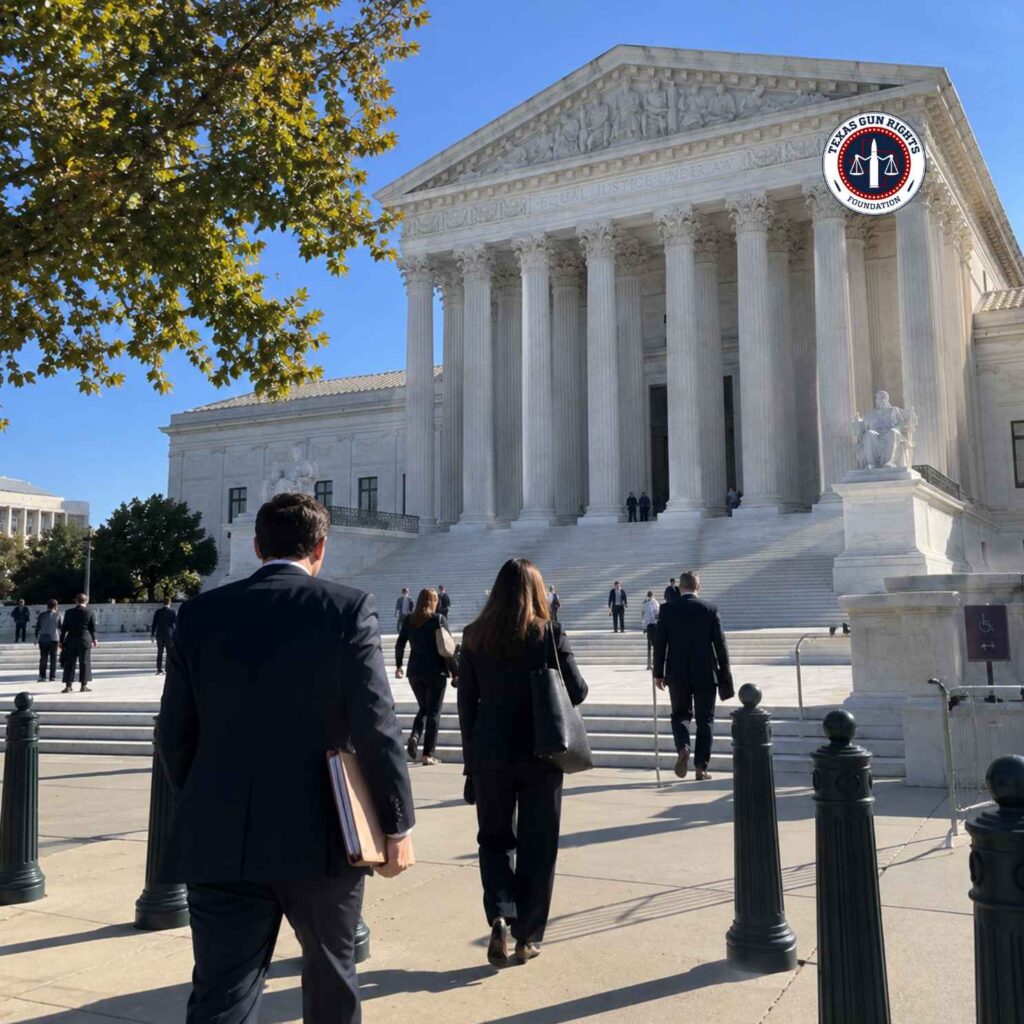
The fight over whether government can ban America’s most popular semiautomatic rifle is moving closer to the Supreme Court lectern, and the U.S. Department of Justice wants a seat at the table.
Just days after Texas Gun Rights Foundation and the National Association for Gun Rights filed an amicus brief urging the Supreme Court to protect AR-15s, the United States asked for permission to participate directly in oral argument.
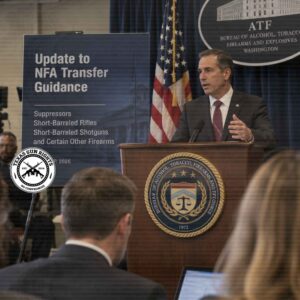
Solicitor General D. John Sauer filed the motion September 9 in Viramontes v. Cook County and Grant v. Higgins, the consolidated cases asking whether the Second and Fourteenth Amendments protect the right to possess AR-15-platform and similar semiautomatic rifles.
The Supreme Court has scheduled oral argument for December 2.
DOJ wants 10 minutes before the justices to argue its position that categorical bans on AR-15 rifles violate the Second Amendment.
DOJ Wants to Make Its Case Directly
The Justice Department has already filed an amicus brief supporting the gun owners challenging the Cook County and Connecticut bans.
Now it wants to argue that position in person.
According to the motion highlighted by AmmoLand, the Solicitor General proposed dividing the Court’s allotted hour into 20 minutes for the gun-owner petitioners, 10 minutes for the United States, and 30 minutes for Cook County and Connecticut.
The Supreme Court docket confirms that the Solicitor General filed a motion “for leave to participate in oral argument as amicus curiae and for divided argument” on September 9.
The motion does not decide the constitutional issue, and the Court still must act on the request.
But DOJ has already made its substantive position clear.
The federal government argues that AR-15s qualify as “arms,” are commonly possessed by Americans for lawful purposes, and cannot constitutionally be subjected to categorical possession bans.
DOJ has pointed to the widespread lawful ownership of these rifles as central to that analysis.
That puts the federal government alongside gun owners and numerous amici asking the Supreme Court to reject the bans.
Texas Gun Rights Already Told SCOTUS to Go Further
On September 3, the Texas Gun Rights and National Association for Gun Rights filed a merits-stage amicus brief supporting the challengers.
The brief asks the Court not merely to resolve the status of AR-15s, but to issue a decision clear enough to provide meaningful guidance to lower courts applying the Supreme Court’s Second Amendment precedents.
TXGR and NAGR argue that the government cannot accomplish indirectly what the Constitution prohibits it from doing directly.
If a firearm is constitutionally protected, the brief argues, the government should not be able to effectively prohibit it by separately banning the magazines, components, or other functional parts necessary to use it.
The brief also addresses a recurring theory in lower-court litigation that treats the AR-15’s potential militia utility as a reason to exclude it from constitutional protection.
The Foundation and NAGR argue the opposite: suitability for militia purposes reinforces the historical case for protection under the Second Amendment.
The organizations also ask the Supreme Court to provide clear guidance for lower courts after it announces the constitutional rule governing these bans.
Their brief points to litigation following decisions such as Bruen and argues that unresolved questions over how Supreme Court precedent applies have generated years of additional litigation over materially similar restrictions.
The Question Before the Court Is Direct
The Supreme Court granted review in the two cases on June 30 and consolidated them for argument.
The question presented is straightforward:
Whether the Second and Fourteenth Amendments guarantee the right to possess AR-15-platform and similar semiautomatic rifles.
The challengers contend that AR-15s are bearable arms commonly possessed by law-abiding Americans and that neither Cook County nor Connecticut can identify a historical tradition supporting categorical bans on such rifles.
The opposing governments are defending restrictions that classify specified semiautomatic firearms as prohibited “assault weapons.”
The scale of civilian ownership will be difficult to ignore.
The 2026 National Firearms Survey estimates that approximately 26.4 million American adults own an AR-15-type or similarly styled semiautomatic rifle, with roughly 40 million AR-15-type rifles and another 20 million similarly styled semiautomatic rifles in private hands.
Those figures are directly relevant to the legal dispute over whether these firearms are in common use for lawful purposes.
A Major Second Amendment Case Heads Toward Argument
On December 2, the Supreme Court is scheduled to hear the constitutional arguments over AR-15 bans directly.
And with the Justice Department seeking its own time before the justices, the Court could hear another argument that categorical bans on firearms owned by millions of ordinary Americans cannot be reconciled with the Second Amendment.
This case could shape Second Amendment law for years to come.
Chip in today to help the Texas Gun Rights Foundation advance constitutional litigation, legal research, and public education defending the right to keep and bear arms.