Imagine needing a federal court order just to legally protect yourself from getting shot.
That was effectively the situation facing ordinary New Yorkers under a state law that prohibited most civilians from purchasing body armor unless they worked in a government-approved profession.
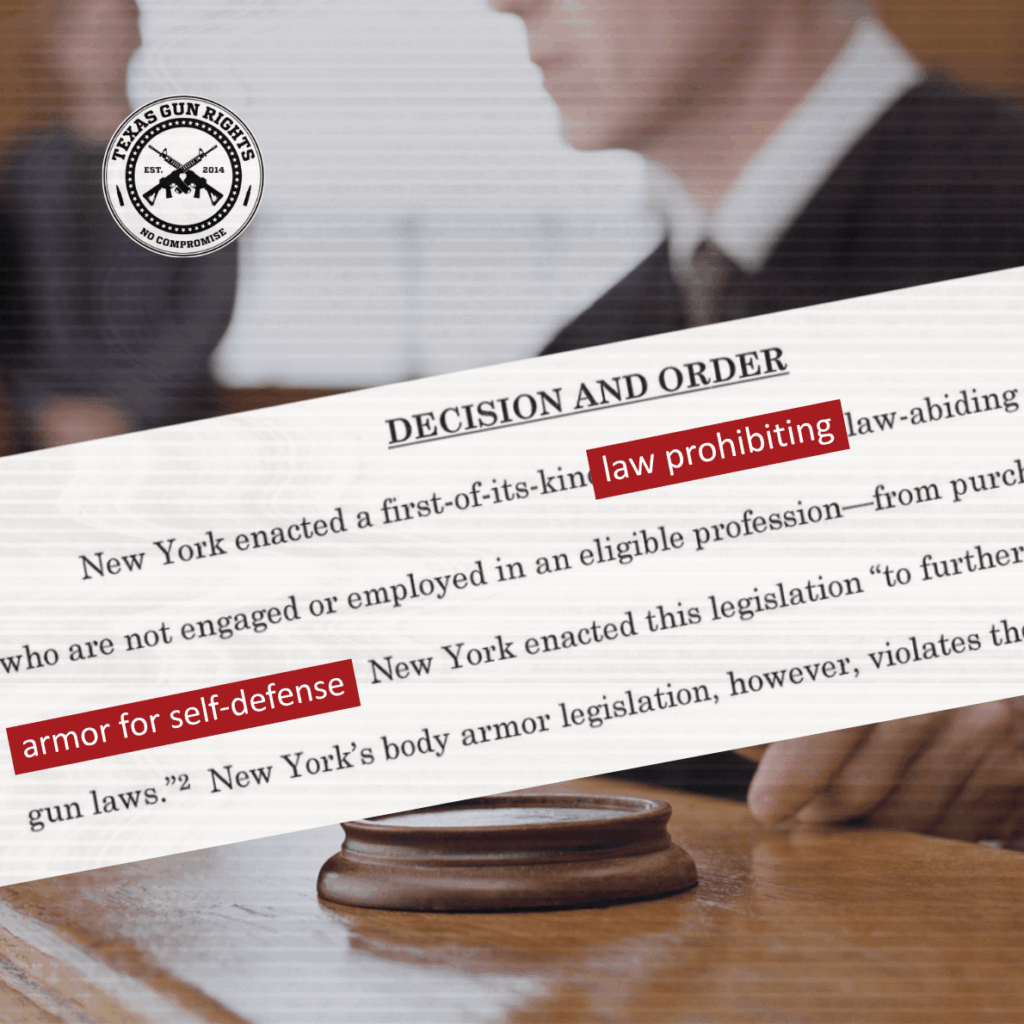
On October 21, 2026, U.S. District Judge John L. Sinatra Jr. struck down New York’s body armor purchase ban, ruling that the restriction violated the Second Amendment.
The decision in Heeter v. James represents a significant victory for Second Amendment advocates and establishes an important principle: The constitutional right to keep and bear arms includes defensive equipment designed to protect human life.
For Texas Gun Rights (TXGR), the ruling reinforces the organization’s position that law-abiding Americans should not have to seek government permission to protect themselves.
New York Made Buying Body Armor a Crime for Ordinary Citizens
In 2022, New York enacted legislation restricting the purchase, sale, and transfer of body armor following the deadly mass shooting at a Buffalo grocery store.
The attacker had worn body armor during the massacre, prompting state lawmakers to impose new restrictions on civilian access to protective equipment.
Under the law, body armor purchases were generally limited to individuals employed in designated professions, including law enforcement officers, military personnel, and certain security and emergency workers.
Ordinary citizens who wanted to purchase body armor for personal protection were largely excluded.
Violating the purchase restriction could result in a Class A misdemeanor for a first offense, with subsequent violations carrying potential felony penalties.
Think about what that meant.
A law-abiding New Yorker concerned about violent crime could legally purchase other forms of personal protective equipment.
But purchasing a bullet-resistant vest could expose that same individual to criminal prosecution.
The state wasn’t simply regulating how body armor could be used during a crime. It was restricting ordinary Americans from acquiring equipment designed to protect them from gunfire.
The Firearms Policy Coalition and individual plaintiffs challenged those restrictions in federal court, arguing that the Second Amendment protects the right to acquire defensive body armor.
Judge Sinatra agreed.
Federal Judge: Body Armor Is Protected by the Second Amendment
In his 47-page decision, Judge Sinatra concluded that body armor qualifies as an arm protected by the Second Amendment.
The ruling relied on the Supreme Court’s decisions in District of Columbia v. Heller and New York State Rifle & Pistol Association v. Bruen.
In Heller, the Supreme Court cited historical definitions of arms that included both offensive weapons and defensive armor.
That distinction matters.
The Second Amendment protects more than the ability to possess firearms. The court concluded that its protections also extend to equipment intended to shield individuals from physical attack.
Under Bruen, once conduct falls within the Second Amendment’s text, the government must demonstrate that its restriction is consistent with the nation’s historical tradition of firearms regulation.
New York failed to meet that burden.
The state could not identify a sufficiently comparable American historical tradition of prohibiting ordinary law-abiding citizens from purchasing defensive body armor.
The court also distinguished historical restrictions on wearing armor in threatening circumstances from New York’s much broader prohibition on acquiring protective equipment.
Judge Sinatra consequently granted summary judgment for the plaintiffs and permanently enjoined enforcement of the challenged purchase and sale restrictions.
The court granted New York a 14-day stay to allow time for an appeal, meaning the injunction is not yet operative during that period. The ruling also leaves intact a separate prohibition on wearing body armor while committing certain violent felonies with a firearm.
The decision is nevertheless a substantial legal setback for New York’s restrictions.
The Government Shouldn’t Decide Who Deserves Protection
The constitutional implications extend beyond body armor.
For Texas Gun Rights, the case illustrates a broader question about the government’s authority to determine which law-abiding Americans may possess the tools necessary for self-defense.
New York’s law allowed designated government personnel and approved professionals to purchase body armor while excluding most ordinary citizens.
Yet those ordinary citizens face many of the same dangers that make protective equipment valuable in the first place.
A convenience store clerk working overnight, a homeowner concerned about violent crime, or a private citizen seeking additional protection should not have to demonstrate government-approved employment to purchase a bullet-resistant vest.
Body armor is defensive by design.
It does not fire a projectile, discharge a weapon, or injure anyone simply by being worn.
Its purpose is to reduce the risk of injury or death when someone is attacked.
Texas Gun Rights President Chris McNutt emphasized the organization’s position:
“Imagine needing a federal judge to tell the government that Americans have the right to protect themselves from getting shot. Absolutely insane.”
The ruling also raises important questions for states that seek to restrict firearms and related defensive equipment based on who the government considers eligible.
If the Second Amendment protects the right to acquire defensive armor, lawmakers must account for that constitutional protection before imposing sweeping civilian purchase prohibitions.
And under Bruen, the government cannot rely solely on modern public-safety arguments to justify a restriction that lacks a sufficient historical foundation.
A Victory for Self-Defense, but the Legal Fight Continues
The October 21 decision is a victory for the plaintiffs, but the legal proceedings may not be over.
New York can seek appellate review, and the court’s temporary stay provides the state an opportunity to challenge the ruling before the injunction takes effect.
For now, the decision stands as an important recognition that the Second Amendment’s protection of arms extends to defensive body armor.
Texas Gun Rights maintains that law-abiding Americans have the right to defend themselves and that government officials should not arbitrarily determine who may acquire ordinary tools of personal protection.
Whether that protection comes from a firearm used to stop a violent attacker or body armor designed to reduce the danger of gunfire, the underlying principle is the same: Americans have a fundamental interest in protecting their own lives.
Support Texas Gun Rights’ Fight for the Right to Self-Defense
The New York body armor ruling is another reminder that constitutional questions involving firearms and defensive equipment continue to be decided in courts across the country.
Texas Gun Rights works to inform gun owners, monitor legislative threats, and advocate for Second Amendment protections in Texas and beyond.
Chip-in to help support TXGR’s legislative advocacy, public education, and efforts to defend the right of law-abiding Americans to protect themselves.