A new Supreme Court brief makes a forceful argument for protecting AR-15s under the Second Amendment: their usefulness as militia arms is a reason for constitutional protection, not a reason to exclude them from it.
But the brief also draws a controversial line.
While defending semiautomatic rifles, it assumes for purposes of its argument that fully automatic firearms may fall outside Second Amendment protection.
That distinction has drawn criticism from gun-rights advocates who argue that protecting one class of bearable arms should not require conceding another.
Attorney G. Antaeus B. Edelsohn filed the amicus brief on August 27 in Viramontes v. Cook County and Grant v. Higgins, the consolidated Supreme Court cases involving bans on AR-15-platform and similar semiautomatic rifles.
The Militia Clause Supports AR-15 Protection
At the heart of the brief is an argument Texas Gun Rights has repeatedly emphasized: the Second Amendment cannot be interpreted to exclude a firearm simply because it has military utility.
The Second Amendment expressly recognizes a “well regulated Militia” as “necessary to the security of a free State.”
Edelsohn argues that history, federal law, the militia system, and the federal government’s long-running support for civilian marksmanship all reinforce the importance of private access to rifles suitable for militia service.
That history is not merely theoretical. The program that became today’s Civilian Marksmanship Program traces its direct lineage to a federally backed marksmanship effort established in 1903, originally tied to national-defense preparedness and civilian rifle proficiency.
That cuts directly against the argument that AR-15s can be banned because of their similarity to military rifles.
The brief argues the opposite.
If the Second Amendment was written in part to preserve an armed citizen militia, then the military usefulness of a rifle strengthens its claim to constitutional protection.
American History Backs the Militia Argument
The brief reaches from the Founding era through the Spanish-American War and into the modern civilian marksmanship system to illustrate the historical connection between privately possessed firearms and military readiness.
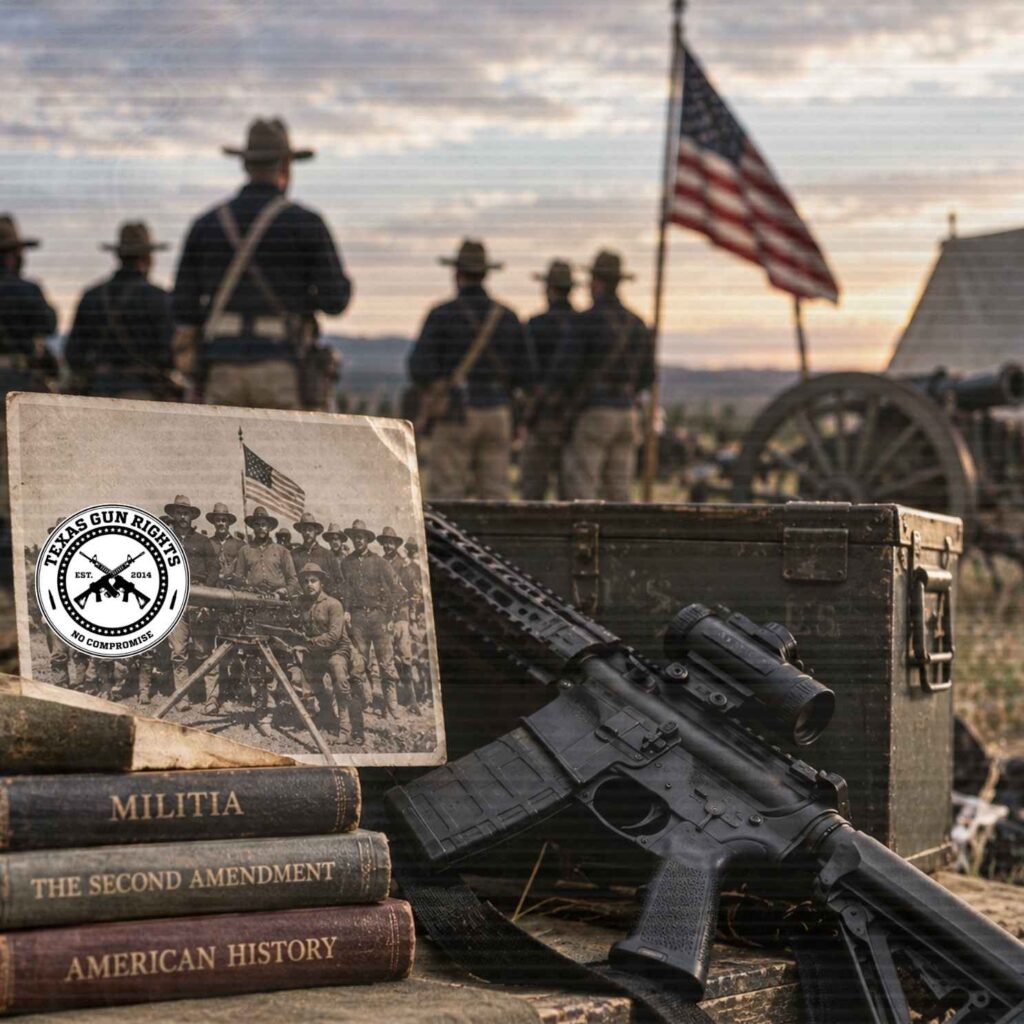
One striking example involves Theodore Roosevelt’s Rough Riders.
During the Spanish-American War, Roosevelt’s volunteer regiment brought two Colt-Browning Model 1895 machine guns to Cuba. Historical accounts describe the guns as privately purchased for the Rough Riders rather than ordinary government-issued equipment.
The example reinforces the brief’s larger historical point: Americans serving in militia and volunteer forces were not always completely dependent on government-issued weapons.
But it also creates tension with the brief’s next argument.
The Brief Draws a Line at Automatic Fire
After building the case that militia usefulness supports constitutional protection, the brief distinguishes AR-15s from machine guns.
Edelsohn writes that, although the Supreme Court has not expressly held that automatic weapons are categorically outside the Second Amendment, there is a “general consensus” that they are not protected. The brief then proceeds by “accepting arguendo” that fully automatic firearms are not protected and distinguishes semiautomatic firearms on the ground that they fire one shot per trigger pull rather than multiple shots from a single trigger function.
That gives the Supreme Court a narrower route for resolving the AR-15 cases without deciding the constitutionality of existing federal machine-gun restrictions.
But it also creates an internal tension.
If militia suitability strengthens an arm’s claim to constitutional protection, the argument becomes harder to reconcile with an assumption that automatic fire may place another bearable firearm outside that protection.
And the Rough Riders example contained in the brief makes that tension especially noticeable.
Protect the Principle, Not Just One Rifle
The Supreme Court does not need to decide the constitutionality of federal machine-gun restrictions to resolve Viramontes and Grant.
The cases before the Court concern semiautomatic rifles.
And on that question, Edelsohn’s brief presents a clear argument: AR-15s should not lose Second Amendment protection merely because they possess characteristics useful for militia service.
Texas Gun Rights, however, takes a broader position on the principle at stake.
“The Second Amendment does not give politicians or judges the authority to pick and choose which bearable arms they think Americans should be allowed to own,” said Chris McNutt, President of Texas Gun Rights.
“The Supreme Court should strike down these AR-15 bans without creating new ammunition for future attacks on the right to keep and bear arms.”
Texas Gun Rights’ position is that the Court can resolve the cases in favor of semiautomatic-rifle owners without deciding broader questions about other classes of firearms.
Help TXGR fight for an AR-15 victory without sacrificing the rest of the Second Amendment.