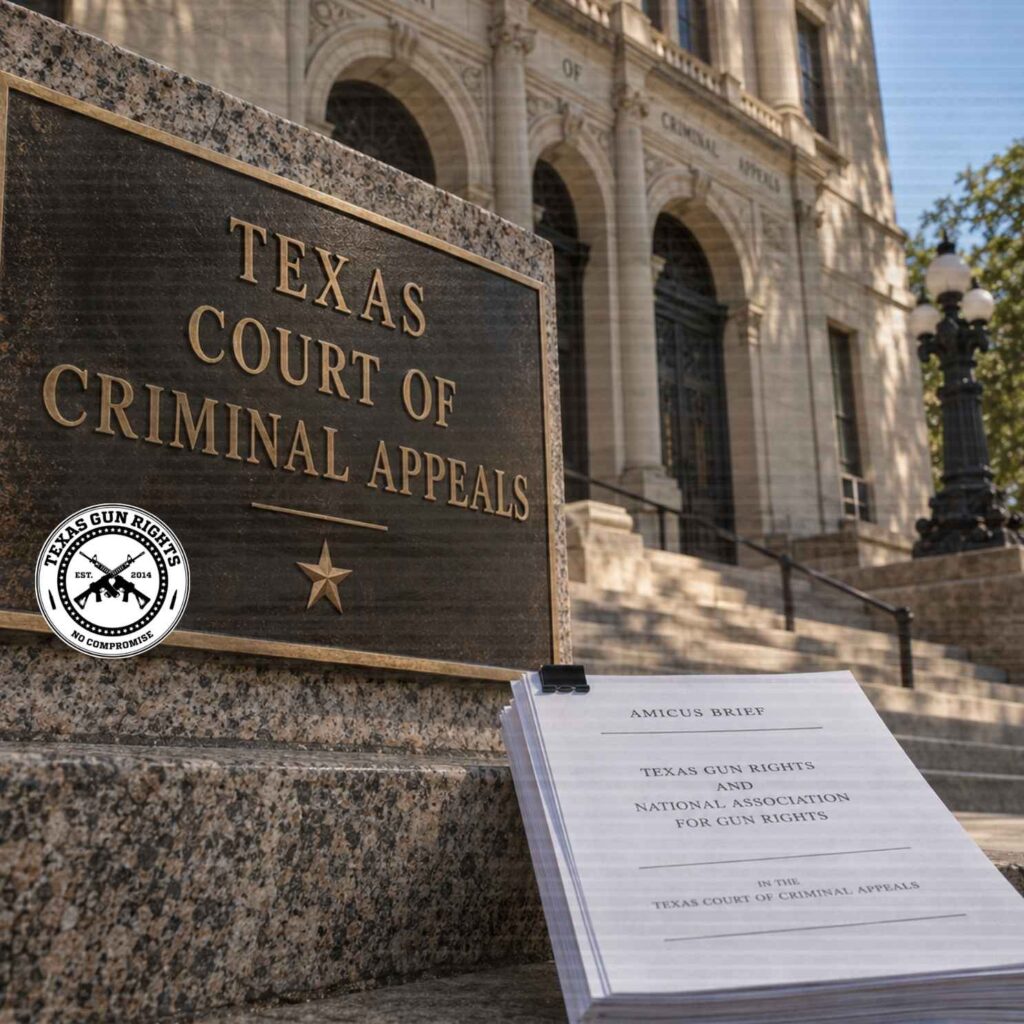
Texas Gun Rights is officially stepping into one of the most important self-defense cases currently before the Texas Court of Criminal Appeals.
Texas Gun Rights and the National Association for Gun Rights have filed an amicus brief in Ballester v. State urging Texas’ highest criminal court to reject the State’s attempt to broaden the legal doctrine of “provocation” and preserve longstanding protections for Texans who act in self-defense.
The brief was filed with the Court of Criminal Appeals on August 31 and accepted September 1.
This is the same case Texas Gun Rights warned supporters about earlier this year — a case that could determine when a Texan loses the right to claim self-defense after being attacked.
Now, TXGR is asking the court directly: Do not erase decades of Texas precedent and replace it with a vague standard that could strip armed citizens of self-defense rights based on nothing more than words, arguments, or conduct someone else finds provocative.
The State Wants to Rewrite “Provocation”
At the center of the case is Texas Penal Code § 9.31(b)(4), which limits a self-defense claim when a person “provoked” another’s unlawful use of force.
But under longstanding Texas precedent, “provocation” has a much narrower legal meaning than simply irritating someone, starting an argument, or saying something that makes another person angry.
In Smith v. State, the Texas Court of Criminal Appeals established three requirements before a provocation instruction can strip a defendant of self-defense.
The defendant’s words or actions must actually cause the attack, they must be reasonably calculated to provoke the attack, and — critically — they must have been used for the purpose of creating a pretext to harm the other person under the guise of self-defense.
That pretext requirement is the line between someone deliberately manufacturing an excuse to attack another person and someone who says or does something contentious only to face an unlawful and potentially deadly escalation.
Texas Gun Rights and NAGR are asking the Court of Criminal Appeals to preserve that line.
The State, meanwhile, is challenging whether Smith’s pretext requirement should control and whether juries should receive an instruction explaining it. Those are the two questions now before the Court of Criminal Appeals, according to the Texas State Prosecuting Attorney’s official case summary.
The Appeals Court Already Found a Serious Error
Israel Ballester was originally convicted of two counts of aggravated assault with a deadly weapon following a confrontation in Milam County. He was acquitted of a separate murder charge.
Ballester maintained that he acted in self-defense.
But when jurors considered that defense, the trial court gave them the statutory language concerning provocation while refusing to provide the established legal definition derived from Smith.
The Third Court of Appeals later reversed Ballester’s aggravated-assault convictions and ordered a new trial, concluding that Smith provides a technical legal definition of provocation and that omitting it from the jury instructions caused harm.
The State then took the fight to the Texas Court of Criminal Appeals.
And that is where the consequences could extend far beyond Ballester himself.
TXGR Brief: The Rule Has Been Settled for Decades
The Texas Gun Rights and NAGR brief argues that the State is not merely asking the court to resolve a technical disagreement over jury instructions.
It is asking the court to dismantle a legal standard that Texas courts have relied upon for nearly half a century.
The brief traces the doctrine back through Texas common law and the drafting of the modern Penal Code.
It argues that when lawmakers adopted § 9.31(b)(4), they incorporated the established doctrine that provocation bars self-defense when someone intentionally manufactures the need to use force as a pretext to harm another person.
The Court of Criminal Appeals recognized that principle in Dirck v. State in 1979, refined it into the three-part test in Smith in 1998, and reaffirmed the importance of pretextual intent in Elizondo v. State in 2016.
The Texas Legislature, meanwhile, has repeatedly amended the state’s self-defense laws without removing that longstanding interpretation of provocation.
The brief argues there is no justification for abandoning it now.
A Vague Standard Could Put Every Armed Texan at Risk
The alternative proposed by the State is where the danger becomes especially clear.
Without the Smith standard, jurors could be left to apply an ordinary understanding of the word “provoked.”
And that word can mean almost anything.
Did someone provoke another person by arguing with him?
Insulting him?
Challenging him?
Making him angry?
Saying something deliberately offensive?
The State itself has pointed to dictionary definitions involving intentionally “annoying” another person or causing someone to behave aggressively.
But as the TXGR and NAGR brief explains, those definitions provide no clear boundary between trying to irritate someone and deliberately manufacturing a violent encounter so you have an excuse to hurt them.
That distinction could mean everything when a Texan is forced to make a split-second decision to defend himself or his family.
Someone should not lose the right to self-defense simply because a prosecutor can convince a jury that something he said made his attacker angry.
The State’s Theory Could Threaten Free Speech, Too
The consequences do not stop with the Second Amendment and the right of self-defense.
TXGR and NAGR also warn that an undefined provocation standard could collide directly with the First Amendment.
Words themselves can potentially form the basis of a provocation claim.
Under the State’s broader theory, someone engaged in offensive, controversial, or politically provocative speech could face an extraordinary consequence if another person responds violently: the attacker’s reaction could be used to help strip the speaker of the right to defend himself.
The brief warns that such a rule risks turning the law into a form of “heckler’s veto,” where a citizen’s rights depend on the reaction of the most volatile person listening.
The longstanding Smith standard prevents that.
It requires more than anger.
It requires more than disagreement.
And it requires more than an attacker deciding he has heard enough.
Before provocation can completely bar self-defense, the State must show that the defendant intentionally manufactured the violent encounter as a pretext to inflict harm.
Texas Gun Rights Is Asking the Court to Hold the Line
This case is bigger than one defendant.
If the Court of Criminal Appeals adopts the State’s theory, prosecutors across Texas could gain a dramatically broader tool for attacking self-defense claims after the fact.
Arguments that once would have centered on whether a citizen reasonably responded to unlawful force could instead become fights over whether something the citizen said or did earlier was sufficiently “provocative.”
That is precisely the danger Texas Gun Rights warned about when this case first reached the state’s highest criminal court.
Now TXGR and NAGR have formally asked the court to reject it.
Their brief urges the Court of Criminal Appeals to affirm the Third Court of Appeals and hold that when jurors are instructed on provocation under § 9.31(b)(4), they must also receive the established legal elements — including the requirement of pretextual intent.
Texans have a fundamental right to defend themselves and their families from unlawful force.
That right should not disappear because a prosecutor can point to an argument, an insult, controversial speech, or some other vague allegation of “provocation.”
Texas Gun Rights will continue fighting to ensure Texas courts do not turn a narrow exception to self-defense into a loophole big enough to swallow the right itself.
Chip in today to help Texas Gun Rights defend the right of Texans to protect themselves and their families — in the Legislature and in the courts.