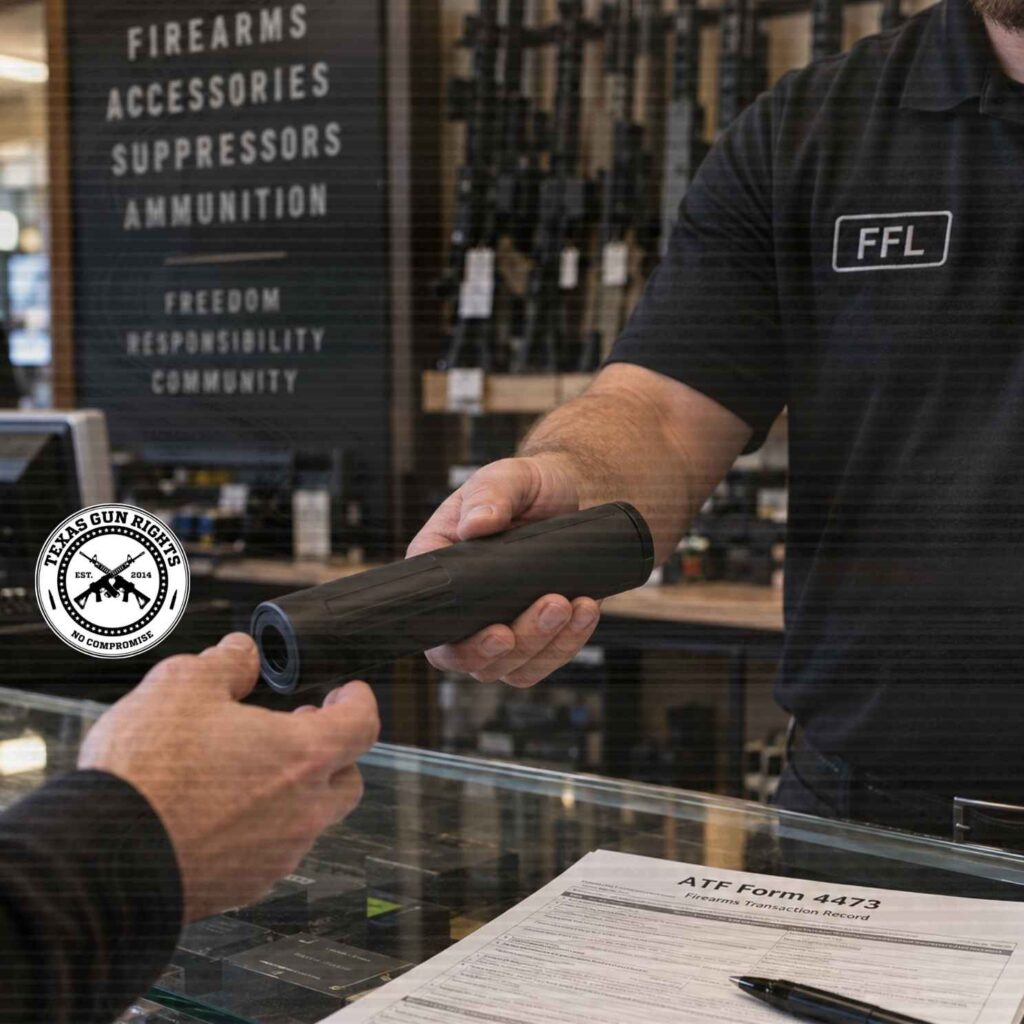
Federal firearms dealers are beginning to transfer suppressors without the traditional NFA Form 4 process for gun owners covered by a federal court injunction — and a new report indicates ATF inspectors are not treating those transfers as violations.
AmmoLand reports that at least four Federal Firearms Licensees in four different states have undergone routine ATF inspections after transferring suppressors using ATF Form 4473 rather than the traditional Form 4 process.
According to the report, all four dealers passed their inspections with zero violations related to those suppressor transfers.
The development follows an August 5 ruling from the U.S. District Court for the Northern District of Texas that permanently blocked ATF, the Department of Justice, and other federal officials from enforcing challenged National Firearms Act provisions governing untaxed firearms against the plaintiffs and, where applicable, their agencies, political subdivisions, members, and customers.
The court expressly limited its relief to the parties and those covered through the organizational plaintiffs rather than imposing a universal nationwide injunction.
That means gun owners who are not protected by the injunction should not assume they can lawfully conduct the same type of transfer.
But for those who are covered, the reported inspections provide one of the clearest real-world indications yet of how ATF personnel are treating suppressor transfers while formal agency guidance remains pending.
Four Dealers, Four Inspections, Zero Suppressor Violations
According to AmmoLand’s investigation, the inspections occurred at FFLs in four different states across the East Coast, South, Midwest, and Southwest.
The inspections were reportedly routine compliance inspections and were not triggered by the suppressor transfers.
All four dealers had transferred suppressors using Form 4473 without requiring the traditional NFA Form 4 process for transactions involving individuals or organizations protected by the federal injunction.
AmmoLand reports that ATF Industry Operations Investigators did not cite those transfers as violations.
The report also says that at least two dealers handled their records by marking suppressors as disposed in their NFA books and moving them into their Gun Control Act records for transfer.
According to AmmoLand’s sources, ATF inspectors accepted that procedure during those inspections.
Those details come from anonymous sources cited by AmmoLand and should not be mistaken for formal ATF policy.
AmmoLand itself cautioned that it could not say whether every ATF inspector or field office would handle the issue the same way.
That is exactly why written guidance still matters.
Texas Court Blocked Enforcement of Key NFA Provisions
The current uncertainty stems from Silencer Shop Foundation v. ATF and the related Jensen v. ATF litigation in the Northern District of Texas.
In his August 5 memorandum opinion and order, U.S. District Judge James Wesley Hendrix concluded that the challenged NFA regulatory provisions for untaxed firearms exceed Congress’s Article I enumerated powers.
The court permanently enjoined ATF, DOJ, and other federal officials from enforcing the challenged provisions against the plaintiffs and, where applicable, their agencies, political subdivisions, members, and customers — including current and future members and customers.
The court did not issue a universal injunction extending relief to everyone in the country, and it did not reach the plaintiffs’ Second Amendment arguments because it resolved the case on Congress’s enumerated powers.
Judge Hendrix initially stayed the effect of his order for seven days to give the federal government an opportunity to seek additional relief.
According to the Second Amendment Foundation’s case-status update, that stay expired at 12:01 a.m. Central Time on August 13, putting the injunction into effect.
That distinction matters.
The ruling did not erase the NFA nationwide, and gun owners should not assume that a 4473-only suppressor transfer is lawful simply because another dealer has conducted one.
But for individuals and dealers who fall within the injunction’s protection, the ruling has created a new legal landscape that ATF is now being forced to address.
ATF Says Guidance Is Coming — Dealers Are Still Waiting
For weeks after the injunction, FFLs and gun owners faced major questions about how ATF intended to implement the court’s order.
On August 28, ATF Director Robert Cekada publicly addressed the controversy.
According to the American Suppressor Association’s report on Cekada’s statement, the ATF Director said the agency respects the court’s ruling and is working on guidance for industry members and individuals affected by the decision.
That acknowledgment is important.
But a public statement from the ATF Director is not the same thing as detailed written guidance explaining exactly how dealers should handle affected transfers, records, inventory, and other compliance questions.
Until that guidance is released, dealers are still being forced to make compliance decisions in a rapidly changing legal environment.
Meanwhile, rumors have circulated claiming ATF issued widespread warnings or cease-and-desist letters over 4473-only suppressor transfers.
AmmoLand reported finding no evidence supporting those claims.
Instead, its investigation identified four dealers that reportedly underwent routine ATF inspections after conducting covered suppressor transfers — without receiving violations for those transactions.
Gun Owners Shouldn’t Have to Guess What ATF Will Do
The reported inspections are an encouraging sign for gun owners and dealers protected by the Texas injunction.
But constitutional rights should not depend on rumors, anonymous reports, or which ATF field office walks through a dealer’s door.
If the federal government is legally barred from enforcing these NFA provisions against covered Americans, then its implementation of that court order should be clear, public, and consistent.
Texas Gun Rights believes ATF and DOJ should promptly issue written guidance that fully respects the injunction and leaves no room for bureaucratic gamesmanship against gun owners or dealers acting within the protection of the court’s order.
The fact that this legal fight produced a major injunction from a federal court here in Texas only makes the stakes clearer.
The National Firearms Act has burdened gun owners for generations. Now that a federal court has ruled that key portions of its regulatory structure for untaxed firearms exceed Congress’s enumerated powers, gun owners should not accept uncertainty or administrative delay as a substitute for compliance with the court’s order.
Texas Gun Rights will continue monitoring ATF’s response, the implementation of the injunction, and any attempt by the federal government to preserve unconstitutional restrictions on firearms and suppressors.
Chip in today to help Texas Gun Rights keep the pressure on the ATF and defend gun owners against unconstitutional federal restrictions.