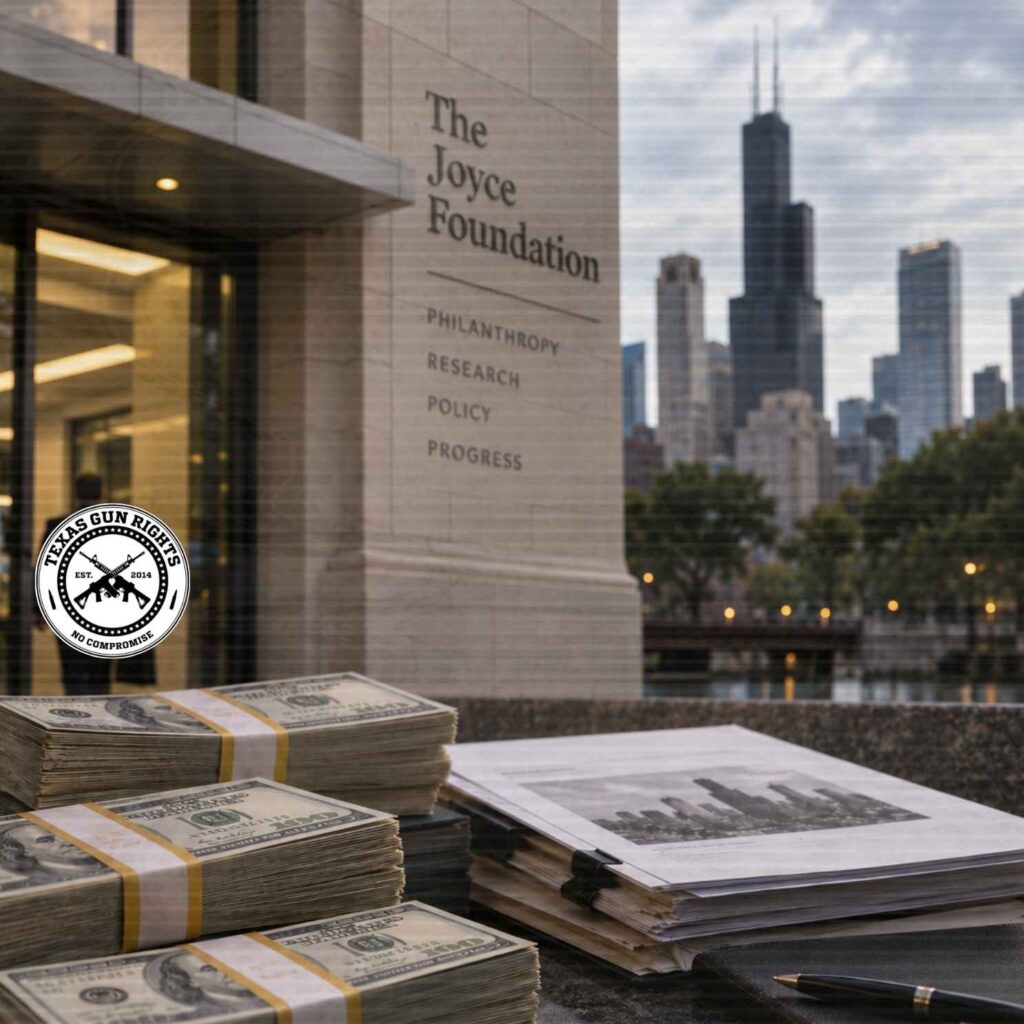
The public face of the gun-confiscation movement is rallies, lobbying, research reports, media campaigns, and demands for new restrictions on firearms.
Behind that activity is a substantial funding infrastructure.
Now, the National Shooting Sports Foundation is putting a spotlight on one of the private foundations helping finance it: the Chicago-based Joyce Foundation.
In an August 26 report examining the foundation, NSSF’s Gun Rights Insights campaign estimates that Joyce has poured nearly $100 million into gun-confiscation efforts over the years.
And Joyce’s own records show just how substantial that investment has been.
In 2019, the foundation disclosed that it had invested $32 million in gun-violence-prevention research over 25 years and that research accounted for about one-third of its total spending in the program during that period.
In other words, NSSF’s nearly $100 million estimate is broadly consistent with the scale of spending Joyce itself has publicly disclosed.
For Texas gun owners, the lesson is simple: the battle over the Second Amendment is not being fought only in legislatures and courtrooms.
It is also being financed by wealthy institutions capable of funding research, advocacy, communications, and organizing for decades.
More Than Three Decades of Gun-Policy Funding
The Joyce Foundation describes itself as a private, nonpartisan philanthropy focused primarily on public policy in the Great Lakes region.
Gun policy has been part of that work for more than three decades.
According to Joyce’s own history, the foundation began making grants for gun-violence research and policy development in 1993, including efforts to treat gun violence as a public-health issue.
Today, “Gun Violence Prevention & Justice Reform” remains one of the foundation’s six major program areas.
And the foundation has substantial resources behind that grantmaking.
According to IRS Form 990-PF data, Joyce reported approximately $1.297 billion in total assets at the end of 2024.
That kind of financial capacity allows a foundation to sustain policy efforts long after a single election, legislative session, or news cycle has ended.
Funding Research, Advocacy and Organizing
Joyce’s influence is not limited to writing checks for academic studies.
The foundation’s own description of its grantmaking strategy shows a much broader approach.
Joyce says its funding can support research and analysis, policy development, communications and media outreach, public education, policy advocacy, coalition building, grassroots organizing, implementation, and evaluation.
Its gun-policy guidelines are similarly explicit.
The foundation says it supports efforts to strengthen gun-violence-prevention policies, conduct research to inform policy development and advocacy, use courts to advance gun policies, engage other funders, conduct communications work, and support public education and grassroots organizing.
That matters because research, advocacy, communications, and political pressure do not exist in isolation.
Research can be cited to support a policy proposal.
Advocacy organizations can then push that proposal before lawmakers.
Communications campaigns can promote it to the public.
Coalitions can organize support around it.
And well-funded organizations can continue that process year after year.
The Money Goes to Major Gun-Confiscation Organizations
Joyce’s public grant database provides concrete examples of where some of that money has gone.
In its November 2025 grant round, the foundation awarded $175,000 to the Violence Policy Center, a Washington-based organization that advocates for additional gun restrictions.
Joyce has also funded the Educational Fund to Stop Gun Violence, including a documented $200,000 grant for work advancing firearm policies and gun-confiscation advocacy.
That organization later merged with the Johns Hopkins Center for Gun Violence Prevention and Policy in 2022 to create the Johns Hopkins Center for Gun Violence Solutions.
Johns Hopkins itself said the merger combined gun-violence research with public-policy advocacy.
Joyce’s grant database also documents funding to the New Venture Fund for gun-policy projects.
Those records include $500,000 for a public-education campaign involving firearms, as well as grants supporting the Fund for a Safer Future and other gun-violence-prevention initiatives.
The foundation has even described its own role as helping build organizing capacity among advocacy groups and developing new sources of financial support for the gun-confiscation movement.
This is not speculation about how the money is being used.
Much of it is documented in the foundation’s own records.
Barack Obama Served on the Joyce Foundation Board
NSSF also highlighted the Joyce Foundation’s history with former President Barack Obama.
That connection is confirmed by Joyce itself.
According to the foundation’s official history, Obama joined its board in 1994, when he was a University of Chicago law lecturer and community organizer, and remained on the board until 2002.
That period overlapped with the early years of Joyce’s gun-violence program, which the foundation says began in 1993.
Obama would later become one of the country’s most prominent advocates for additional federal gun restrictions as President.
His past service on the Joyce board does not, by itself, establish responsibility for any particular grant or policy initiative.
But it illustrates the foundation’s long history of operating in circles connected to major national policy debates.
Why This Matters to Texas Gun Owners
The Joyce Foundation is not based in Texas, and much of its state and local grantmaking is concentrated in the Great Lakes region.
But its influence does not necessarily stop at those state lines.
Joyce says it also explores policy solutions nationally and at the federal level, and its grants have supported organizations engaged in national research, advocacy, public education, and policy development.
That makes the funding network relevant to Texas gun owners.
Federal gun-confiscation proposals affect Texans.
National research can be cited in Austin.
National advocacy groups can pressure Texas lawmakers.
And messaging developed and financed elsewhere can quickly become part of the political fight here at home.
Texas Gun Rights believes gun owners should know who is financing the organizations, research, and advocacy pushing for additional restrictions on their rights.
The other side has institutions with billion-dollar balance sheets and the ability to finance policy campaigns for years.
Ignoring that infrastructure would be a mistake.
Texas Gun Rights will continue exposing the organizations, money, and political machinery working to restrict the Second Amendment — and fighting back when those policies come to Texas.
Chip in today to help Texas Gun Rights fight the big-money gun-confiscation machine and defend our Second Amendment rights.