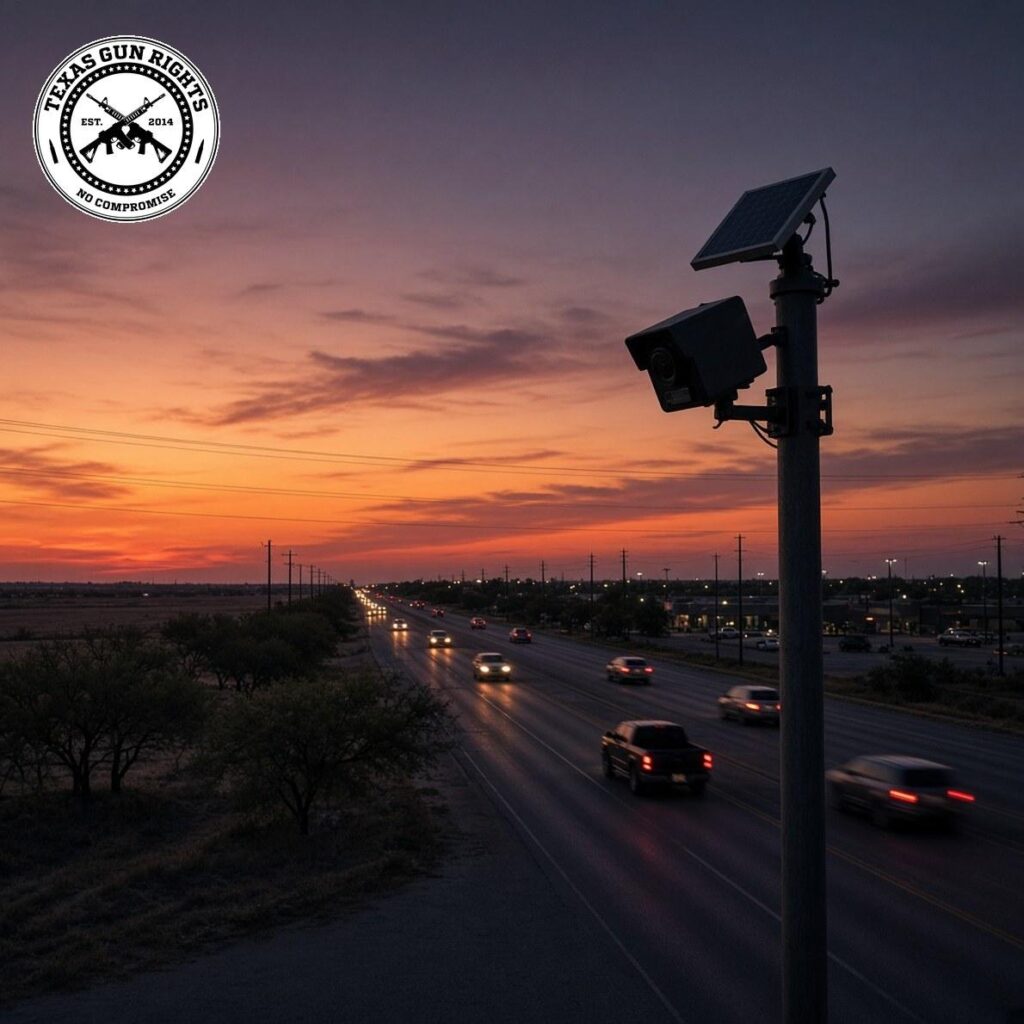
Texas Gun Rights opposes two “regulate, don’t ban” bills that would keep Flock-style cameras scanning Texans and is pressing for a complete ban, through a stronger HB 847 and a Democrat’s broader HB 331.
Texas Gun Rights opposes two bills filed for the 90th Legislature that would take the Flock-style license plate reader network Texans have been fighting city by city and give it a permanent home in state law.
The first is HB 763 by Rep. Mary González (D-San Elizario). It reads like a limit. Its first rule says a governmental entity may not operate a plate reader “for any purpose.” Then the bill text lists the exceptions. Government may run the cameras and use the data to investigate any felony, to identify unregistered or uninsured vehicles, to investigate missing persons, to recover stolen cars, to collect tolls and enforce parking, and to control access to secured areas.
None of those uses requires a warrant.
That is not a ban on Flock cameras. It is a state license for them. Any felony investigation, and every routine insurance and registration check, would justify scanning every car on the road. HB 763 does have useful pieces: 48-hour deletion, a ban on federal sharing, an exclusionary rule and a $1,000 private lawsuit. But a deletion clock only starts after the government has photographed everyone.
HB 1167 Goes Further Toward Making Flock Permanent
HB 1167 by Rep. Salman Bhojani (D-Euless) doesn’t pretend to ban anything. It writes a rulebook for police and fire agencies and the private vendors that run their systems.
The bill assumes the cameras stay on. It says “the incidental collection of a plate image by an operating system does not, without more, authorize an individualized search.” Before searching historical plate data for a particular vehicle, an officer needs only documented reasonable suspicion, not a warrant.
HB 1167 has real limits. Data must be deleted within 30 days, including vendor copies. Agencies and vendors can’t sell the data or hand out bulk access. Buying plate data from a private company other than the agency’s own vendor requires a warrant.
But the dragnet stays up. Enforcement runs through the Department of Public Safety and the attorney general, and the bill expressly creates no private cause of action for damages. Agencies wouldn’t have to comply until September 1, 2028.
Texans have already seen what rules on paper are worth. In Colleyville, TXGR reported that audit logs showed more than 2.2 million searches without a case number, while officials told the public every search was documented. TXGR opposes both “regulate, don’t ban” bills.
TXGR’s Priority: A Complete Ban on Flock Cameras
TXGR’s priority is a complete ban on government use of Flock cameras and every other license plate reader.
Rep. Brian Harrison (R) helped start that conversation in Austin. He filed HB 3999 in 2023 and HB 961 in 2025 to require a warrant or court order before police could use a plate reader. Both bills died in House committee without a vote. Harrison is continuing the fight this session with HB 847.
Under the bill, police may use a plate reader only under a warrant or court order, only to investigate violent offenses, and must destroy the data promptly unless it is tied to such a case. TXGR supports HB 847 and is encouraging Harrison to strengthen it into a complete and total ban.
On November 9, the day the bill was filed, TXGR thanked Rep. Harrison’s office, confirmed its support and sent ten suggested changes:
- Coverage: Apply it to every governmental entity and anyone acting for one, so cities, school districts and toll authorities can’t keep running or sharing these systems.
- Private networks: Bar agencies from buying, querying or receiving data from private networks, including HOA and business Flock cameras and data brokers, without a warrant for a specific vehicle. TXGR called this the biggest loophole.
- Warrant: Drop “or court order” and require a probable-cause warrant naming a specific vehicle.
- Scope: Cover make, model, color and other vehicle-identifying data, not just plate numbers.
- Retention: Delete non-matching scans within 24 hours, cap case data at 180 days unless it becomes evidence, and purge existing data within 30 days of the effective date.
- Sharing: Ban sharing with federal agencies, other states and private parties, including one-time sharing.
- Vendor contracts: Make conflicting contracts void.
- Enforcement: Add a private lawsuit for $1,000 per violation or actual damages plus attorney’s fees, waive immunity, count each scan as a separate violation, and add attorney general civil penalties and a cutoff of state grants for violators.
- Evidence: Make illegally collected data inadmissible.
- Narrow exceptions: Allow only tightly drawn exceptions for toll billing and active Amber and Silver Alerts.
The Surprise: A Democrat Filed the Broadest Ban
The enforcement model in point eight already exists in a filed bill, and its author is a Democrat.
HB 331 by Rep. John Bucy III (D-Austin) is the strongest outright ban filed so far. The bill text is one sentence long where it counts: “A governmental entity may not use an automatic license plate reader.”
It covers the state, every political subdivision, and their officers and employees. It has no warrant workaround. A Texan harmed by a violation can sue for $1,000 or actual damages plus attorney’s fees, and the bill waives government immunity. As written, it has no exception for tolls or parking.
TXGR supports HB 331. TXGR judges a bill by what it does, not by its author’s party, and HB 331 shows that ending government plate tracking has support on both sides of the aisle.
All four plate-reader bills are in the House. No Senate bill on license plate readers has been filed so far.
“HB 763 and HB 1167 don’t stop Flock cameras. They hand them a state license,” said Chris McNutt, President of Texas Gun Rights. “Texas should strengthen HB 847 into a complete ban, borrow the private lawsuit already in HB 331, and reject every bill that keeps the cameras watching law-abiding Texans.”
TXGR has warned that these cameras can log trips to gun stores, ranges, gun shows and Second Amendment meetings.
Rules for a dragnet still leave a dragnet. Texas needs a complete ban.
Sign TXGR’s DeFlock Texas petition to demand a statewide ban on warrantless plate-reader tracking.
Chip in to Texas Gun Rights to defeat the “regulate, don’t ban” bills and win a complete ban on Flock cameras this session.