Manor ended its relationship, Leander froze its cameras, and Texans across the state are demanding an end to warrantless surveillance.
Texas Gun Rights has been warning for months that Flock cameras are creating the infrastructure for a massive government surveillance network.
We first warned that interconnected license-plate readers could allow government agencies to reconstruct where Texans travel—including visits to gun stores, shooting ranges, gun shows, and Second Amendment events. We later exposed how Fort Worth was integrating Flock’s plate-reader network with automated police drones.
Now Texans are beginning to fight back.
Cities and police departments across the state are freezing cameras, cancelling contracts, and questioning whether the promises surrounding Flock’s surveillance system can actually be trusted.
And the revolt is growing.
Texas Communities Are Turning the Cameras Off
On September 3, the Manor Police Department announced it was ending its relationship with Flock Safety.
The department acknowledged that license-plate readers can help investigate crimes, but said maintaining the trust of the community was more important.
That same day, the Leander City Council voted unanimously to freeze its Flock cameras after residents raised concerns over privacy, transparency, data sharing, hacking, and the potential for abuse.
They are not alone.
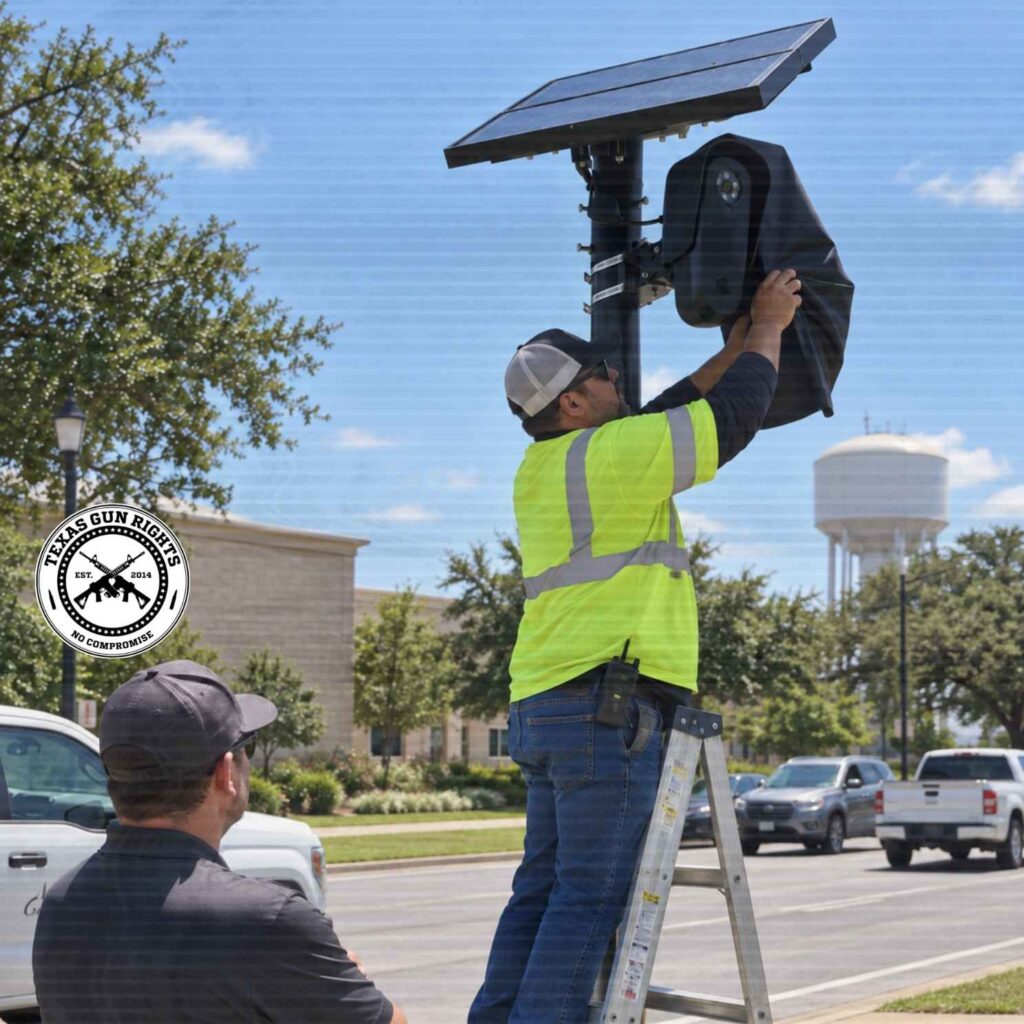
El Paso Police halted use of its Flock cameras. Bastrop officials voted unanimously to cover theirs. Elgin paused its system. And Wylie rejected renewal of its Flock contract after more than 700 residents reportedly signed a petition demanding action.
The grassroots pressure is working.
But Texans should not have to fight this battle city by city.
The Risks Are No Longer Hypothetical
Flock and its defenders routinely argue that the technology is simply another tool for solving crimes.
But incidents across the country demonstrate why building a searchable surveillance network around millions of innocent motorists deserves far more scrutiny.
In Dunwoody, Georgia, public records revealed that Flock employees accessed live camera feeds from locations including a children’s gymnastics room, pool, playground, school, and community center as part of product demonstrations for prospective law-enforcement customers. Flock confirmed that the access occurred and said Dunwoody participated in a demonstration partnership.
In Minnesota, automotive journalist Joel Feder was driving a Range Rover provided for a vehicle review when four police cars surrounded him and his wife after Flock cameras repeatedly matched the vehicle to an incomplete stolen-plate entry in a national database.
The vehicle was not stolen.
A human data-entry error combined with the surveillance network had allowed police to track the innocent vehicle before the encounter. Flock later emphasized that alerts should be only one part of an investigation rather than the sole basis for a stop.
And in Colorado, police used Flock records to accuse Chrisanna Elser of stealing a package.
She had driven through the town—but she had not committed the theft.
Elser spent days assembling GPS information, dash-camera recordings, surveillance footage, and other evidence to prove she was somewhere else when the crime occurred. The case was ultimately dropped.
These cases involve different failures.
That is precisely the point.
Once government and private companies construct the infrastructure to monitor and search people’s movements, Texans are asked to trust that the technology will never be misused, the data will never be wrong, access will always remain limited, and every future government official will exercise restraint.
Gun owners have heard those promises before.
Texans Aren’t Buying It
A new statewide poll shows the backlash is not confined to a few vocal city council meetings.
An Overton Insights survey of 1,167 likely Texas voters found 63.6 percent oppose local governments using automatic license-plate readers such as Flock cameras, compared with just 28.1 percent who support them.
More than half—roughly 51 percent—said they strongly oppose the technology. Opposition crossed party lines.
Governor Greg Abbott has also ordered state agencies to stop providing state funding for Flock cameras after reporting revealed that at least $30 million had been directed toward building out the network.
The state-supported expansion helped install at least 3,200 Flock cameras, including nearly 1,200 being installed through a DPS agreement.
Stopping that money is a good start.
But a funding pause is not a permanent protection.
Cities can still operate cameras with other money. Existing networks remain in place. Agencies can still share and search information. And nothing prevents a future governor or Legislature from turning the funding back on.
Texas does not need temporary promises. Texas needs law.
Austin Must Finish the Job
During the 2025 legislative session, Representative Brian Harrison filed H.B. 961 to restrict automated license-plate readers, require judicial authorization in many circumstances, limit data sharing, and require unrelated records to be destroyed.
Austin buried the bill without a vote.
Texas Gun Rights intends to make sure that does not happen again.
Through our DeFlock Texas campaign, TXGR is demanding legislation that:
- BANS warrantless state and local government tracking through Flock and other automated license-plate-reader networks;
- PROHIBITS Texas agencies from feeding Texans’ movements into federal or national surveillance databases;
- REQUIRES prompt deletion of information unrelated to legitimate criminal investigations; and
- STOPS government surveillance of lawful Second Amendment activity.
“The politicians are finally discovering what Texans already understand: you cannot build a statewide surveillance grid and then tell us to simply trust whoever controls it,” Texas Gun Rights President Chris McNutt said.
“Pausing a few cameras and cutting off state funding is progress. But Texas does not need ‘guardrails’ around warrantless mass surveillance. We need enforceable protections that stop government from tracking innocent Texans in the first place.”
For gun owners, the danger remains especially clear.
The government does not need your rifle’s serial number if it can identify everyone who regularly visits a gun store, shooting range, gun show, firearms-training facility, or gun-rights meeting.
That is backdoor tracking of gun owners.
The growing revolt in Manor, Leander, Wylie, Bastrop, Elgin, El Paso, and other Texas communities proves these cameras are not inevitable.
Texans are pushing back.
Now it is time to turn those local victories into statewide law.
Tell Governor Abbott and the Texas Legislature: DeFlock Texas and stop warrantless government tracking before this surveillance network is weaponized against law-abiding gun owners.