The Supreme Court left Maryland’s public carry bans in place. Justice Thomas wrote that those bans stand on questionable historical ground, and that a more focused case should decide how far “sensitive places” can go.
The Supreme Court refused to hear a challenge to Maryland’s map of gun-free public places on November 16. Justice Clarence Thomas agreed with that denial. He also made clear he does not buy the legal theory behind it.
In a statement respecting the denial in Novotny v. Moore, No. 25-1324, Thomas wrote that he is “skeptical” each of Maryland’s restrictions “is consistent with this Nation’s historical tradition of firearm regulation” in “sensitive places.”
In “an appropriate and more narrowly focused case,” he said, the Court “should consider the scope of States’ authority to ban firearms in ‘sensitive places.'”
A denial is not a ruling that Maryland’s law is constitutional. It leaves the bans in force and leaves the question for a tighter case.
What Maryland Banned, and Why the Court Passed
Maryland law bars a law-abiding person from carrying a firearm at public demonstrations, on mass transit, in places of amusement, in healthcare facilities, in locations that sell alcohol for on-site consumption, and across tens of thousands of acres of state park and forest land.
The Fourth Circuit upheld those restrictions on the ground that each one banned guns in a “sensitive place.”
The petitioners asked the Supreme Court to take the whole package. Thomas said he agreed the Court should not grant review in this case because “each Maryland statute implicates a distinct historical tradition of firearm regulation,” and “the breadth of petitioners’ challenge would complicate our review.”
That is a warning about the vehicle, not a blessing of the bans.
In New York State Rifle & Pistol Association v. Bruen, the Court recognized only a narrow historical tradition of banning weapons in a few sensitive places, such as legislative assemblies, polling places, and courthouses.
It warned that expanding that category “to all places of public congregation” would “eviscerate the general right to publicly carry arms for self-defense.”
Thomas says states have done exactly that. He pointed to New Jersey’s list of at least 25 locations, including zoos, public libraries, casinos, and state-owned beaches; New York’s 20 “sensitive” sites, from places of worship to certain residential health settings; and California’s 29 gun-free spaces, including athletic facilities, financial institutions, and government-permitted public gatherings.
“These restrictions stand on questionable historical ground,” he wrote. Their “cumulative effect is to prohibit firearms wherever people gather for eating, drinking, recreation, amusement, and free speech,” which he called “an affront to the right of ‘law-abiding citizens’ to ‘carr[y] arms in public for’ their ‘ordinary self-defense.'”
Lower courts, he added, “have largely blessed these ahistorical ventures.”
He said he has “serious doubts that our Nation’s historical tradition of firearm regulation supports many of these sweeping restrictions,” and that the Court should, in an appropriate case, “consider whether particular sensitive-place laws are consistent with the right to public carry.”
The Same Theory, Closer to Home
The “sensitive places” label is how governments try to make ordinary public life a gun-free zone without admitting they are attacking the right to carry.
Texas already bars firearms in some locations under state law. In the first week of bill filing for the 90th Legislature, anti-gun Democrats proposed going much further.
Rep.-elect Pooja Sethi’s HB 776, filed November 9, would make it a crime to possess a gun within 1,000 feet of school property, or inside a school bus, without the school’s written authorization.
As Texas Gun Rights has described the filed text, License to Carry holders would get no exception for that surrounding 1,000-foot zone. In much of urban Texas, that kind of radius turns entire neighborhoods into gun-free sitting-duck zones.
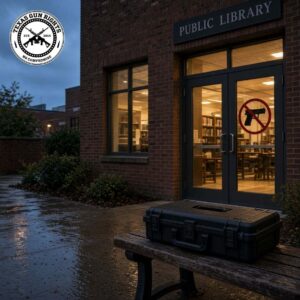
Rep.-elect Samantha Lopez-Resendez’s HB 960, also filed November 9, would make it a crime to carry a visible handgun in a public library, license or not.
Those bills are not before the Supreme Court. They rest on the same idea Thomas just called into question: that government can keep adding places to the forbidden list until a lawful carrier has nowhere ordinary left to go.
“Justice Thomas just told the country these sweeping ‘sensitive place’ bans rest on shaky historical ground,” said Texas Gun Rights Foundation President Chris McNutt.
“A denial is not a blessing of Maryland’s map, or of any law that tries to turn parks, transit, libraries, and everyday public life into gun-free zones. The Second Amendment does not stop at the statehouse steps, and the Court should say so in a focused case.”
The Court left Maryland’s bans standing on November 16. Thomas’s statement is the map for the case that should come next.
Chip in to the Texas Gun Rights Foundation to fund education and legal research on the right to carry, and on the “sensitive places” theory now being used to shrink it.