
The Supreme Court takes up AR-15 bans on December 2. Twenty years of FBI data show rifles’ share of gun murders fell after the federal ban expired.
For 30 years, the gun-confiscation lobby has called the AR-15 a weapon of war that must be banned to save lives.
The FBI’s own numbers point the other way.
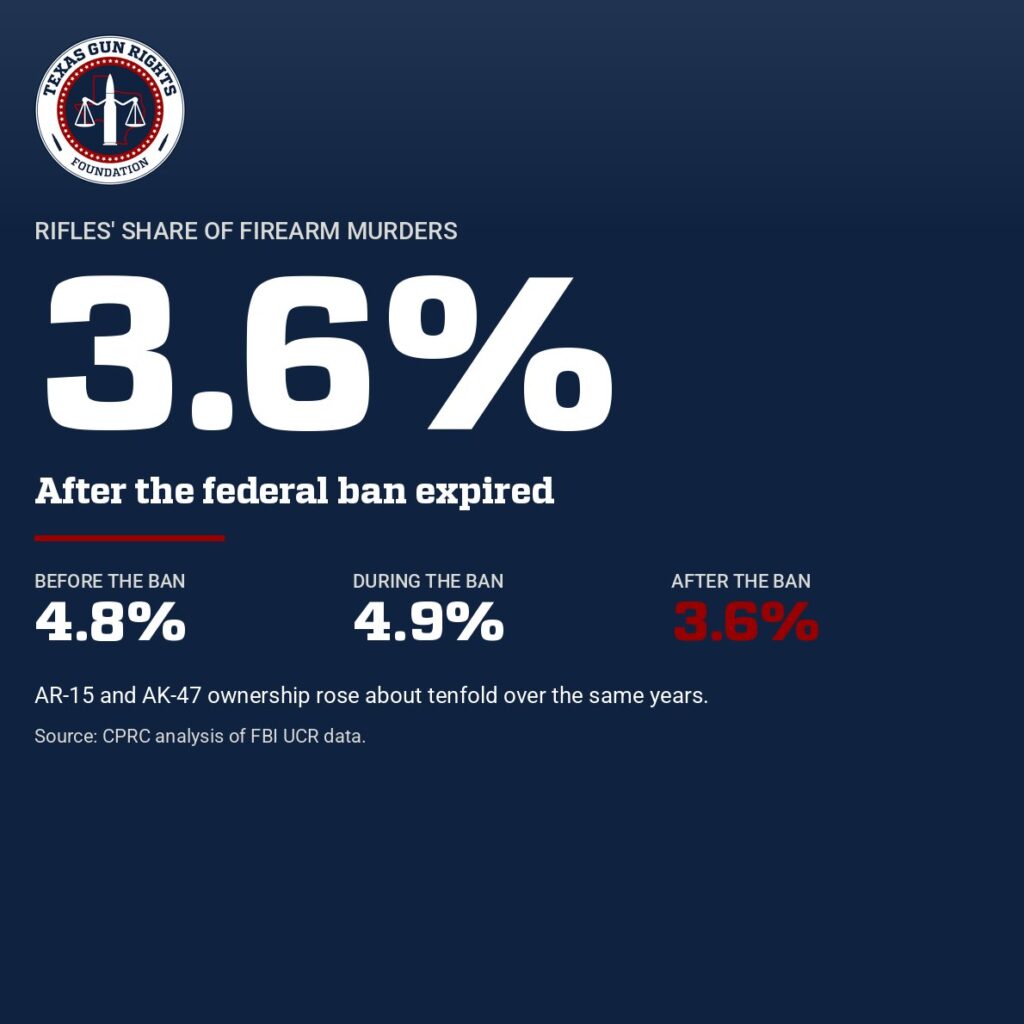
A November 4 analysis by the Crime Prevention Research Center found that rifles of every kind accounted for 4.9 percent of firearm murders while the federal “assault weapons” ban was in force from 1995 through 2004.
After the ban expired, that share fell to 3.6 percent. Over the same stretch, CPRC estimates, the number of AR-15s and AK-47s per 100 Americans rose about tenfold.
That record matters now.
On December 2, the U.S. Supreme Court hears argument in Viramontes v. Cook County, No. 25-238, consolidated with Grant v. Higgins, No. 25-566, the challenges to Cook County’s and Connecticut’s bans on AR-15-platform and similar semiautomatic rifles.
What the FBI Data Show
CPRC built its analysis from FBI Uniform Crime Reporting data and posted the underlying spreadsheet for anyone to check.
The federal ban took effect in September 1994 and expired in September 2004. CPRC’s averages for rifles’ share of firearm murders:
- Before the ban (1991 to 1994): 4.8 percent
- During the ban (1995 to 2004): 4.9 percent
- After the ban (2005 to 2025): 3.6 percent
- First ten years after the ban: 3.86 percent
CPRC reports that the drop from the ban years to the post-ban years is statistically significant. It found no statistically significant difference between the years before the ban and the years during it.
Going from 4.9 to 3.6 percent is a decline of roughly a quarter in rifles’ share.
Every Rifle Counts in the FBI Total
The raw numbers are small. CPRC’s spreadsheet for 2025 lists:
- 357 rifle murders
- 9,663 firearm murders
- 13,378 murders overall
That rifle count covers every kind of rifle: bolt-action deer rifles, lever guns, .22s and AR-15s alike.
The FBI category doesn’t separate out the guns these bans target, so the share for AR-15s alone can only be smaller.
Ownership Soared. The Rifle Share Didn’t.
Here’s the fact the ban’s defenders have to answer.
CPRC estimates there was about one AR-15 or AK-47 per 100 Americans when the ban expired in 2004, and 10.2 per 100 in 2025.
If these rifles drove murder, a tenfold jump in ownership should show up in the data. It doesn’t.
Rifles’ share of gun murders went down after the ban, not up.
Correlation is not causation, and CPRC’s figures don’t prove that letting the ban expire caused the decline. They don’t need to.
The case for the ban rested on the claim that these rifles are a unique public-safety threat. Twenty years of the FBI’s own data, gathered while Americans bought rifles by the millions, cut against that claim.
“The gun-confiscation lobby spent 30 years telling Americans the AR-15 fills our morgues,” said Texas Gun Rights Foundation President Chris McNutt. “The FBI’s own numbers say rifles of every kind averaged 3.6 percent of gun murders after the ban expired, even as ownership exploded. When the facts don’t support a ban, the people pushing it fall back on fear.”
Why the Numbers Aren’t the Constitutional Test
Statistics are useful for setting the record straight. They aren’t what decides whether a ban is constitutional.
Two Supreme Court rulings set the test:
- District of Columbia v. Heller (2008): the Second Amendment protects an individual right and protects arms in common use for lawful purposes.
- New York State Rifle & Pistol Association v. Bruen (2022): the Court rejected judicial interest balancing and held that a gun law must be consistent with the nation’s historical tradition of firearm regulation.
Under that test, a government can’t ban a commonly owned rifle just by showing, or claiming, that the ban serves public safety.
That’s why the briefs in the Cook County case matter so much.
As the Foundation reported, Cook County lumps ordinary semiautomatic rifles in with machine guns and grenades as “unusually dangerous weapons.” Connecticut dismisses reliance on the tens of millions of Americans who own AR-15s as a “trivial counting exercise.”
The FBI data answer the “unusually dangerous” label on the facts. Heller and Bruen answer it on the law.
Texas has no statewide ban on these rifles, but the rule the justices write after December 2 will govern rifle challenges in every state, including this one.
The case for banning America’s most popular rifle was built on fear. The record of the last 20 years was built on data.
Support the Texas Gun Rights Foundation as it explains the facts and the law behind the Supreme Court’s rifle case to Texans.