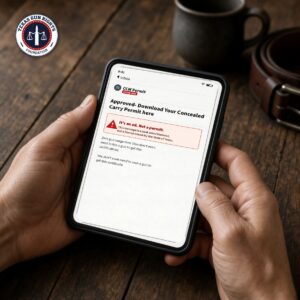
A Texan can be cleared by the U.S. Attorney General to own firearms again and still commit a third-degree felony under Texas law by carrying one outside his home.
Texas Gun Rights is calling on the 90th Legislature to end that contradiction by recognizing federal firearm rights restorations granted under 18 U.S.C. § 925(c).
Washington Reopened the Door. Texas Still Blocks the Exit.
For more than three decades, federal rights restoration existed only on paper. Beginning in 1992, Congress barred ATF from spending appropriated funds to process § 925(c) applications, rendering the program unusable. A DOJ final rule published August 20, 2026 revived it.
Relief is not automatic. The Attorney General grants it only after an individualized review finds the applicant is not likely to act in a manner dangerous to public safety and that relief would not be contrary to the public interest. This is not a blanket amnesty. It is the federal government looking at one person’s record and deciding he should be armed again.
Texas ignores that decision. Under Texas Penal Code § 46.04(a), a person convicted of a felony may not possess a firearm until five years after release from confinement or supervision, and after that only “at the premises at which the person lives.” Possession anywhere else is a third-degree felony. A § 925(c) grant removes federal disabilities only, so it does nothing to that state prohibition.
The License to Carry is closed too. Government Code § 411.172 bars anyone “convicted of a felony,” and § 411.171(4) already excludes convictions that were expunged, pardoned, or set aside. A federal restoration of firearm rights is not on that list.
The result: a Texan who clears the federal government’s public-safety review is still treated as a felon in possession the moment he steps off his own property armed.
David Hart’s Fight Shows What’s at Stake
Texas Gun Rights member David Hart knows that wall firsthand.
As TXGR has reported, Hart’s 2003 nonviolent drug possession conviction came during a devastating stretch of loss, homelessness, and addiction. He served his time and rebuilt his life. He built a business, served as a firefighter, and joined the Texas State Guard. NBC 5 reported in May 2025 that more than two dozen state lawmakers backed his bid for a pardon.
The Texas Board of Pardons and Paroles still denied him. Because the Texas Constitution allows the Governor to pardon only on the Board’s written recommendation, his effort ended there.
Hart is now pursuing federal restoration. He has not yet received it. If he does, Texas law as written will still confine his rights to his front door.
He is not alone. DOJ opened its restoration portal to the public on November 4, and its 5,000-applicant limit filled the same day. The next window opens January 4, 2027, for just 500 more, as TXGR reported November 6. Thousands of Americans are lining up to prove they deserve their rights back. Texas should not tell the ones who succeed that it does not count here.
“When the Attorney General of the United States looks at a man’s record and restores his gun rights, Texas has no business arresting him for exercising them,” said Texas Gun Rights President Chris McNutt. “Texas honors a pardon. It must honor a federal restoration too, and the Legislature should fix this in the first weeks of session, not leave men like David Hart locked out for another two years.”
What Texas Must Pass
Texas Gun Rights is calling on the Legislature to pass a clean fix with four parts:
- A § 46.04 exception for anyone holding a § 925(c) grant that has not been revoked, was issued after the conviction, and has not been followed by a new disqualifying conviction.
- License to Carry recognition, adding a federal restoration to the expunctions, pardons, and set-aside convictions Texas already excludes from the felony bar. Every other LTC requirement would still apply.
- DPS recording within 30 days of receiving a certified grant, with notice to the FBI for the national background-check system and no fee charged.
- An arrest bar so no officer can arrest a restored Texan under § 46.04 based solely on a conviction that predates the grant when he shows the grant or DPS records reflect it.
Texas already trusts a pardon to restore firearm rights. A § 925(c) grant is narrower, limited to firearms, and issued only after the federal government finds the person is not a danger. There is no principled reason to honor one and ignore the other.
Washington has reopened the door. Texas must stop standing in it.
Chip in to Texas Gun Rights today to help make federal gun rights restoration count in Texas.