
Only Texas DPS can issue a Texas License to Carry, and eligible Texans can already carry without one. Texas Gun Rights Foundation exposes the red flags in misleading online permit advertisements and explains what to do if you’ve already paid.
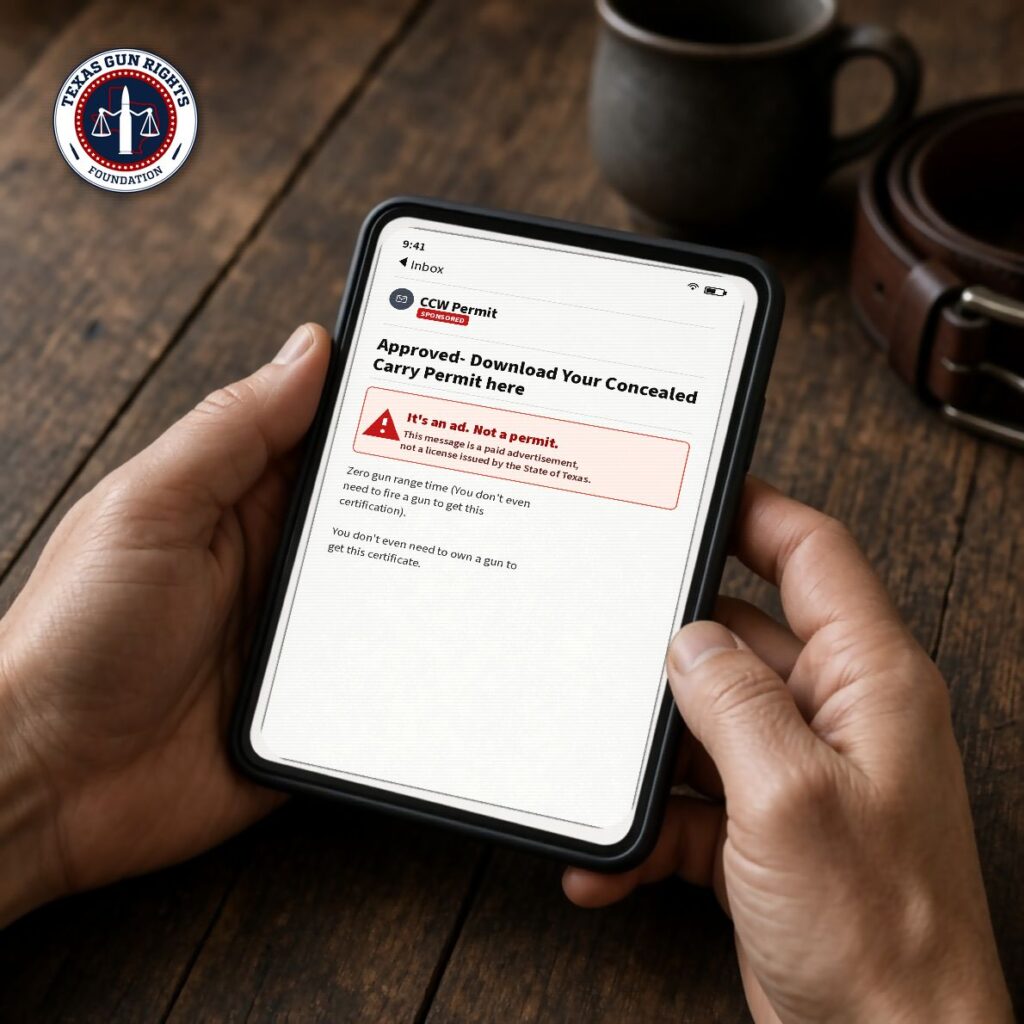
A slick email is landing in Texas inboxes with a subject line built to stop you cold: “Approved- Download Your Concealed Carry Permit here.”
You didn’t apply for anything. Nobody approved anything. And no advertisement in your inbox can hand you a government-issued carry permit.
Texas Gun Rights Foundation recently obtained a copy of one such email received by a Texan. Several others have alerted TXGRF President Chris McNutt to similar programs being promoted on social media, including AI-style mini-drama commercials designed to drive viewers toward online carry certifications.
The email comes from “CCW Permit” at newsletter@vipgunowners.net. It is a sponsored affiliate advertisement, and its own fine print says the sender “may receive commissions from purchases you make.”
It pushes an online “Concealed Carry Certification” with promises of “Zero gun range time (You don’t even need to fire a gun to get this certification),” “You don’t even need to own a gun to get this certificate,” and “31 states have agreed to accept this certificate so far.”
Then comes the pressure: “It’s important you download it ASAP as anti-gun groups are trying to get rid of it.”
And this sales pitch is hardly new.
A promotional email published in January 2024 used nearly identical language, including the zero-range-time promise, the 31-state claim, and a warning that the website could be shut down tomorrow. The older advertisement does not establish that the same company is behind both promotions, but it demonstrates that this supposedly urgent opportunity has been marketed with virtually the same script for nearly three years.
Texas Gun Rights Foundation wants Texans to know exactly what they’re being offered before reaching for a credit card.
A Certificate Is Not a Permit
In Texas, only the Department of Public Safety issues a Texas License to Carry (LTC). No affiliate marketer or online certification company can issue one independently.
The standard training requirements are established by Government Code Section 411.188. Applicants ordinarily complete four to six hours of classroom instruction and demonstrate handgun proficiency through live-fire qualification.
The classroom portion can be completed online, but only through a DPS-approved course provider. Standard applicants must also complete in-person range instruction and shooting qualification with a DPS-qualified handgun instructor. Special exemptions exist for qualifying military personnel and veterans who can document prior firearms proficiency.
DPS-approved online courses are legitimate. Completing one can satisfy the classroom-training requirement. But a training course is not a Texas carry license.
DPS says instructors enter training results into the applicant’s RSD Connect account. The applicant must also meet eligibility requirements and complete the state’s licensing process.
A downloadable certificate advertised as requiring no range time is not a substitute for that process.
And while applicants don’t necessarily need to own a handgun to complete legitimate training, that fact alone does not make an advertised certification a government-issued permit.
Texans Already Have the Right to Carry Without a License
Here is what the “download it ASAP” crowd won’t tell you. Texas gun owners already won this fight.
House Bill 1927, Constitutional Carry, was signed June 16, 2021, and took effect September 1, 2021.
Under Penal Code Section 46.02, eligible Texans 21 and older who are not otherwise prohibited may carry handguns without a license, subject to restrictions on where and how firearms may be carried.
No certificate. No permission slip. No download.
Adults 18 to 20 also have legal protection. In Firearms Policy Coalition v. McCraw, a federal court ruled in August 2022 that Texas could not prohibit otherwise eligible young adults from carrying solely because of their age. The Texas State Law Library explains that the state may not prosecute those adults under that restriction based solely on age.
DPS also confirms that it no longer denies LTC applications solely because applicants are between 18 and 20.
A real LTC still has value.
Texas maintains recognition arrangements with numerous other states, although travelers must comply with each state’s laws. A valid Texas LTC may serve as an alternative to a NICS background check for qualifying dealer purchases. And Texas law generally requires an LTC for lawful concealed handgun carry on college campuses where campus carry is permitted.
None of those benefits comes automatically from a privately issued online certificate.
Red Flags to Watch For
- A misleading “Approved” subject line. If you never applied for a permit, ask what was supposedly approved and by which government agency.
- Urgency and scare tactics. Claims that anti-gun groups are about to shut down an opportunity are designed to pressure buyers. The same warning appeared in promotional copy in January 2024.
- Affiliate commission disclosures. Fine print identifying a sponsored advertisement or paid referral tells you the sender has a financial interest in your purchase.
- “No range time” promises. Standard Texas LTC applicants must complete live-fire qualification. Special exemptions do not turn a generic online certificate into a Texas LTC.
- “31 states accept it” claims. Legitimate nonresident permits exist, and Texas issues LTCs to qualifying out-of-state residents. But a permit must come from an actual issuing authority. Demand the name of the issuing state and verify recognition directly with the states where you intend to carry.
The most important question is simple: Which government agency actually issues the credential you’re buying?
If the answer is unclear, don’t pay.
If You Already Paid
Save the advertisement, receipt, emails, and any certificate you received.
If the product was misrepresented, request a refund from the seller and contact your credit-card issuer about disputing the charge. Explain what was advertised and what you actually received.
The Consumer Financial Protection Bureau advises consumers to report disputed charges promptly. To preserve applicable billing-error rights, a written notice generally must be sent within 60 days after the charge appears on the statement. Different procedures may apply to disputes involving delivered goods or services.
You can also report potentially deceptive advertising to the Federal Trade Commission at ReportFraud.ftc.gov and the Texas Attorney General’s Consumer Protection Division.
“Texas gun owners fought for years to get the government’s permission slip out of the way,” said Texas Gun Rights Foundation President Chris McNutt. “Now marketers are trying to sell it back to you as a download. Your right to carry doesn’t come from a PDF, and it doesn’t come from an email that says ‘Approved.'”
Know Your Rights. Don’t Buy a Fake Shortcut.
Texas Gun Rights Foundation is committed to helping Texans understand their Second Amendment rights, navigate firearm laws, and recognize misleading claims about lawful gun ownership.
Before purchasing any online carry course or certification, verify the provider, the actual credential being offered, and the requirements of the state that supposedly recognizes it.
And if you’ve received a similar advertisement, save a copy. Misleading carry-permit marketing deserves scrutiny, especially when it targets Texans who may not know the difference between firearm training, a certificate, and a government-issued license.
Your right to carry doesn’t come in an email. It comes from God, and Texas gun owners fought to get the state out of the way.
This article provides general legal education, not individualized legal advice. Check current law and applicable licensing requirements before carrying a firearm.
Chip in today to help the Texas Gun Rights Foundation expose misleading carry-permit schemes and educate Texans about their Second Amendment rights.