
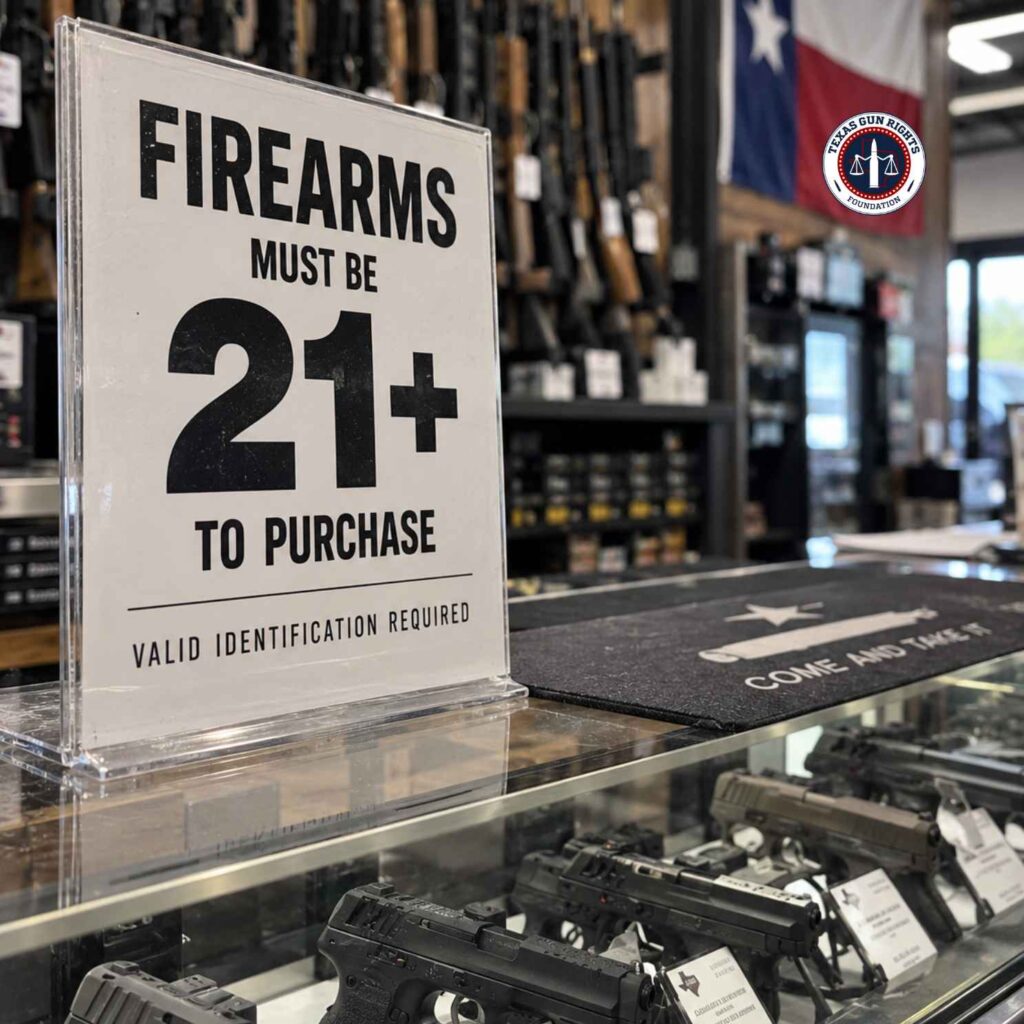
The Justice Department’s Office of Legal Counsel says the federal government cannot constitutionally impose criminal penalties on licensed dealers for selling handguns to otherwise law-abiding adults ages 18 to 20—a major shift that puts the Executive Branch behind an argument already accepted by the Fifth Circuit.
The U.S. Department of Justice has taken a major new position on the Second Amendment: adults do not have to wait until their 21st birthday to become part of “the people” protected by the right to keep and bear arms.
In a September 17 legal opinion, DOJ’s Office of Legal Counsel concluded that 18 U.S.C. §§ 922(b)(1) and (c)(1) are unconstitutional as applied to otherwise law-abiding adults between 18 and 20 who seek to purchase handguns.
Those provisions of the Gun Control Act generally prohibit federally licensed firearms dealers from selling handguns or handgun ammunition to people under 21.
The Justice Department went further than merely questioning the restriction. In its September 18 announcement, DOJ said the provisions may not be enforced to impose criminal penalties on dealers who sell handguns to otherwise law-abiding adults ages 18 to 20.
That is a major change in the federal government’s constitutional position.
But it is not a repeal.
The statutes remain in the U.S. Code, courts remain divided over age-based firearm restrictions, and federal guidance will have to be reconciled with DOJ’s new position.
DOJ: Adults 18 to 20 Are Part of “The People”
The Office of Legal Counsel began with the Second Amendment’s text.
It concluded that adults between 18 and 20 are among “the people” whose rights the amendment protects and that handguns are protected “arms.”
The opinion also rejected the idea that the Second Amendment can protect possession while leaving the government free to block ordinary commercial acquisition.
That distinction matters because the federal restriction technically regulates licensed sellers. It does not categorically prohibit an 18-, 19-, or 20-year-old from possessing a handgun.
Under federal law, young adults have historically been able in some circumstances to receive handguns through gifts or private intrastate transfers.
DOJ concluded that those alternative channels do not cure the constitutional problem created by excluding young adults from the primary commercial firearms market.
The opinion also emphasized the legal status of 18-year-olds elsewhere in American law: they can vote, serve on juries, face adult criminal punishment, and become subject to military obligations.
For DOJ, the key question was not whether policymakers believe 21 is a preferable minimum age.
The question was whether the government could identify a historical tradition sufficient to justify the restriction under the Supreme Court’s modern Second Amendment framework.
OLC concluded it could not.
“This is what happens when government is finally forced to start with the Constitution instead of treating the Second Amendment as an exception to it,” said Texas Gun Rights Foundation President Chris McNutt. “An 18-year-old does not become one of ‘the people’ three years later because he walks into a gun store. If the government wants to restrict an enumerated right, it has to prove that restriction is constitutionally grounded.”
Founding-Era History Cuts Against the Federal Ban
The historical record was central to DOJ’s analysis.
OLC found that Founding-era militia laws strongly undermine the idea that Americans between 18 and 20 were categorically outside the armed citizenry.
The opinion reports that 249 of more than 250 militia statutes enacted by the colonies and early states around the Founding required militia service by 18-to-20-year-olds.
The federal Militia Act of 1792 likewise enrolled able-bodied male citizens beginning at age 18 and required those enrolled to provide themselves with arms.
That history matters because once protected conduct falls within the Second Amendment, the government must identify a historical tradition sufficiently analogous to the modern restriction.
OLC also examined one of the principal arguments used to defend modern age restrictions: the Founding-era common-law “infancy doctrine.”
At the time, people under 21 generally had limited contractual capacity, and contracts entered by minors could often be disaffirmed.
DOJ concluded that this was not a meaningful historical analogue for the federal handgun restriction.
The infancy doctrine was a general rule of private contract law designed largely to protect minors from unfavorable bargains. It did not prohibit firearm purchases, criminalize merchants for selling firearms to young adults, or categorically prevent cash transactions.
The modern federal restriction operates very differently. A licensed dealer who willfully violates federal age restrictions can face criminal penalties and licensing consequences.
OLC therefore concluded that the two regimes differ in who they regulate, why they regulate, and how they operate.
The opinion also examined later firearm-sale restrictions but concluded that scattered laws enacted well after the Founding were insufficient to establish the historical tradition necessary to sustain the federal prohibition.
For Texas, DOJ Has Now Joined the Fifth Circuit
The development is especially significant in Texas because the Fifth Circuit has already reached essentially the same constitutional conclusion.
In Reese v. ATF, the Fifth Circuit held in January 2025 that the federal restrictions on licensed handgun sales to adults ages 18 to 20 are inconsistent with the Second Amendment.
The court concluded that adults in that age range are protected by the Second Amendment and that the government failed to establish a historical tradition supporting the modern prohibition.
That put Texas, Louisiana, and Mississippi at the center of the national legal fight over young adults’ firearm rights.
DOJ has now adopted the same core constitutional position for the Executive Branch.
That does not make the Office of Legal Counsel equivalent to the Supreme Court.
An OLC opinion does not bind Article III courts. But OLC provides authoritative legal advice within the Executive Branch, which means its conclusion can materially affect how DOJ approaches enforcement of federal law.
The federal government is no longer merely facing the argument that its under-21 handgun restriction violates the Second Amendment.
Its own legal office now agrees.
The Statute Is Still on the Books
That does not mean every practical question has already been resolved.
The current text of 18 U.S.C. § 922 still contains the federal age restriction.
Congress has not repealed it.
The OLC opinion instead addresses whether the Executive Branch may constitutionally enforce those provisions against licensed dealers selling handguns to otherwise law-abiding adults ages 18 to 20.
There is also an implementation question.
ATF’s existing age guidance has stated that federally licensed dealers may not sell handguns or handgun ammunition to people under 21.
That guidance will now have to be considered alongside DOJ’s new constitutional position and whatever implementation instructions follow.
State law remains a separate issue.
The OLC opinion does not invalidate state age restrictions, determine the legality of every firearm transfer in every jurisdiction, or eliminate other federal prohibitions that may independently make a particular person ineligible to receive a firearm.
It is also limited to the handgun-sale provisions DOJ analyzed.
A Broader Shift in Second Amendment Enforcement
The significance of this development reaches beyond one age restriction.
For decades, many firearm laws were defended under balancing tests that weighed asserted government interests against burdens on the right.
The Supreme Court rejected that approach in Bruen.
DOJ’s new opinion instead works through the modern framework: determine whether the Second Amendment’s text covers the people, arms, and conduct at issue, then require the government to establish a historically grounded justification for the restriction.
Under that framework, OLC concluded that the federal government could not justify excluding otherwise law-abiding adults ages 18 to 20 from licensed handgun sales.
The opinion also reinforces a broader issue increasingly important in Second Amendment litigation: the right to keep arms cannot be entirely separated from the ability to acquire them.
A constitutional right to possess a handgun would provide limited protection if the government could exclude an entire class of law-abiding adults from purchasing one through ordinary commercial channels.
“The Second Amendment does not say the right begins at 21,” McNutt said. “The government spent decades enforcing a restriction against legal adults without the historical foundation the Constitution requires. The fact that DOJ itself is now acknowledging that problem should matter far beyond this one statute.”
The statutory language remains in federal law.
But the constitutional position of the federal government has changed dramatically.
For Texas gun owners, that shift is especially significant because DOJ’s conclusion now points in the same direction as the Fifth Circuit: otherwise law-abiding adults do not lose Second Amendment protection simply because they are 18, 19, or 20 years old.
Support the Texas Gun Rights Foundation’s work advancing Second Amendment litigation, legal research, and constitutional education.