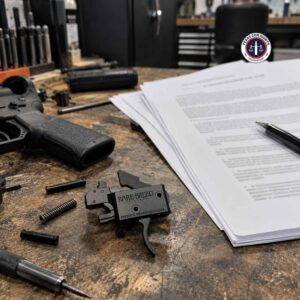

A divided Fifth Circuit says the Second Amendment protects the right to purchase firearms and that the federal government failed to identify a historical tradition supporting its categorical ban on direct interstate handgun sales.
One of the Gun Control Act of 1968’s major restrictions on handgun purchases has been struck down by the U.S. Court of Appeals for the Fifth Circuit.
In a 2-1 opinion issued September 18, the court held that the federal ban preventing Americans from directly purchasing handguns from federally licensed dealers outside their state of residence violates the Second Amendment.
The ruling came in Elite Precision Customs v. ATF, a challenge brought by Firearms Policy Coalition, Texas firearms dealer Elite Precision Customs, and individual plaintiffs Tim Herron and Freddie Blish.
Judge Jerry E. Smith, joined by Judge Kurt Engelhardt, concluded that the challenged federal provisions regulate conduct protected by the Second Amendment and that the government failed to demonstrate a sufficiently analogous historical tradition supporting the restriction.
The court reversed the district court’s dismissal and rendered judgment for the plaintiffs.
Judge Catharina Haynes dissented, saying she would have upheld the challenged provisions.
For Texas gun owners, the decision is significant not only because of the interstate handgun restriction itself.
The majority also reinforced a broader principle with consequences far beyond this case: the constitutional right to keep arms necessarily includes the right to acquire them.
Federal Law Forced Handgun Buyers Through a Second Dealer
The challenged restrictions arise from three provisions of 18 U.S.C. § 922.
Together, §§ 922(a)(3), 922(a)(5), and 922(b)(3) generally prevent direct interstate handgun transactions.
Federal law contains an exception allowing a federally licensed dealer to sell a rifle or shotgun directly to an out-of-state resident when the transaction complies with the laws of both states.
There is no comparable exception for handguns.
Instead, a buyer who wants a handgun from an out-of-state dealer generally must have the firearm transferred to another federally licensed dealer in the buyer’s home state. The buyer then completes the transaction through that second dealer.
That additional dealer must agree to participate, and the transaction commonly involves another fee and additional delay.
That was not theoretical in Elite Precision.
Elite Precision Customs is a federally licensed Texas dealer that said it would sell handguns directly to customers from other states if federal law permitted it.
Blish, an Arizona resident, and Herron, a New Mexico resident, said they wanted to purchase handguns directly from the Texas dealer.
Herron told the court that intermediary dealers typically charged him between $30 and $40 and delayed his ability to take possession.
The federal government argued that because buyers could still obtain the handgun through this dealer-to-dealer process, the interstate restriction did not meaningfully interfere with their Second Amendment rights.
The Fifth Circuit rejected that reasoning.
The majority said the existence of another, more burdensome route does not transform a categorical purchase prohibition into something outside the Second Amendment.
“The right to keep and bear arms does not mean much if government can simply shut down ordinary ways of acquiring those arms and then point to a more expensive workaround,” said Texas Gun Rights Foundation President Chris McNutt. “The Fifth Circuit recognized the obvious: the right to keep a firearm necessarily includes the ability to lawfully acquire one.”
The Right to Keep Arms Includes the Right to Buy Them
The majority relied heavily on the Fifth Circuit’s earlier decision in Reese v. ATF, which struck down the federal restriction on licensed handgun sales to otherwise law-abiding adults ages 18 to 20.
In Reese, the court stated that the right to keep and bear arms necessarily implies a right to purchase them.
Elite Precision applies that principle directly to interstate handgun sales.
The government could not avoid Second Amendment scrutiny, the majority concluded, simply because the law targets the commercial transaction used to obtain a firearm rather than possession of the firearm after the sale.
Nor was the court persuaded that alternative purchasing options made the restriction constitutionally insignificant.
The majority distinguished the interstate ban from a limited waiting period. No amount of waiting allows a resident of one state to directly purchase a handgun from a licensed dealer in another state under the challenged federal scheme.
The court also expressed concern about imposing additional financial costs on the exercise of a constitutional right through a mandatory intermediary.
That reasoning could have consequences in future challenges involving firearm acquisition.
Federal and state governments regulate firearms at numerous points before possession ever begins—including purchase procedures, waiting periods, transfer requirements, dealer restrictions, permits, fees, and other conditions.
Elite Precision does not automatically invalidate those regulations.
But it strengthens the Fifth Circuit’s position that acquisition cannot simply be placed outside the Second Amendment and treated as constitutionally irrelevant.
The Government’s Historical Analogues Failed
Once the court concluded that direct handgun purchases fall within the Second Amendment, the government had to show that the restriction is consistent with the Nation’s historical tradition of firearm regulation.
The government offered 18 historical laws.
The Fifth Circuit found them insufficient.
The majority grouped much of the government’s evidence into three categories: wartime restrictions designed to preserve arms for the common defense, restrictions involving trade with foreign sovereigns or Indian tribes, and early forms of consumer-protection regulation governing matters such as firearm or gunpowder quality.
The court concluded that those laws did not establish a historical tradition of preventing ordinary, peaceable citizens in one American state from purchasing a handgun directly from a licensed seller in another.
That distinction became especially important when the majority addressed another federal appeals court.
In United States v. Vereen, the Second Circuit upheld an interstate firearm restriction after concluding that historical regulations involving movement of firearms and gunpowder across colonial borders provided sufficient support.
The Fifth Circuit expressly rejected that approach.
The majority said historical analogues cannot be evaluated at such a high level of generality that important differences in who was regulated, why they were regulated, and how the restriction operated disappear.
That disagreement creates a substantial divide between federal appellate courts over both firearm acquisition and the historical justification for interstate restrictions.
The Circuit Split Raises the Stakes
The appellate conflict may be one of the most important consequences of the decision.
The Second Circuit has accepted a constitutional theory that the Fifth Circuit has now explicitly rejected.
That means federal law is being interpreted differently by two federal appellate courts on an important Second Amendment question.
The Fifth Circuit covers Texas, Louisiana, and Mississippi.
And unlike an unpublished trial-court ruling, Elite Precision is a published appellate decision that can shape how federal courts throughout the circuit analyze future firearm-acquisition cases.
The case also arrives during a period in which the Fifth Circuit has repeatedly confronted foundational questions about what activities the Second Amendment protects.
The court has now said in multiple contexts that government cannot separate the right to possess a firearm from the ability to obtain one.
That could become increasingly important as courts consider restrictions that do not directly outlaw possession but instead regulate the process of purchasing, transferring, or otherwise acquiring arms.
“This decision matters well beyond one trip across a state line,” McNutt said. “Government has spent decades building restrictions around the theory that it can heavily burden the acquisition of firearms without burdening the right to keep them. The Fifth Circuit is making clear that constitutional rights cannot be sliced apart that way.”
What the Decision Does Not Do
The ruling should not be read more broadly than the court wrote it.
The Fifth Circuit addressed the federal provisions that collectively prohibit direct interstate handgun purchases.
It did not strike down federal dealer licensing.
It did not invalidate background checks.
It did not eliminate laws barring prohibited persons from possessing firearms.
And it did not erase state laws governing firearm sales, possession, or eligibility.
The decision also does not mean every interstate firearm transaction is automatically lawful regardless of the laws of the states involved.
There is another important procedural point.
The panel issued its decision on September 18, and further appellate proceedings remain possible. The federal government may seek rehearing, and Supreme Court review is also possible.
Gun dealers and buyers therefore should not treat a newly issued appellate opinion as an instruction to immediately disregard existing federal procedures before the ruling’s procedural status and implementation are clear.
What Elite Precision does establish is the Fifth Circuit’s constitutional conclusion: the federal government cannot defend a categorical ban on direct interstate handgun purchases merely by pointing to another, more burdensome route for obtaining the same protected arm.
The government also must do more than produce historical firearm regulations in the abstract.
It must show a tradition that actually fits the modern restriction.
In this case, the Fifth Circuit concluded it could not.
For the broader Second Amendment fight, that combination may prove more important than the interstate-sales issue alone.
Support the Texas Gun Rights Foundation’s work advancing Second Amendment litigation, legal research, and constitutional education.