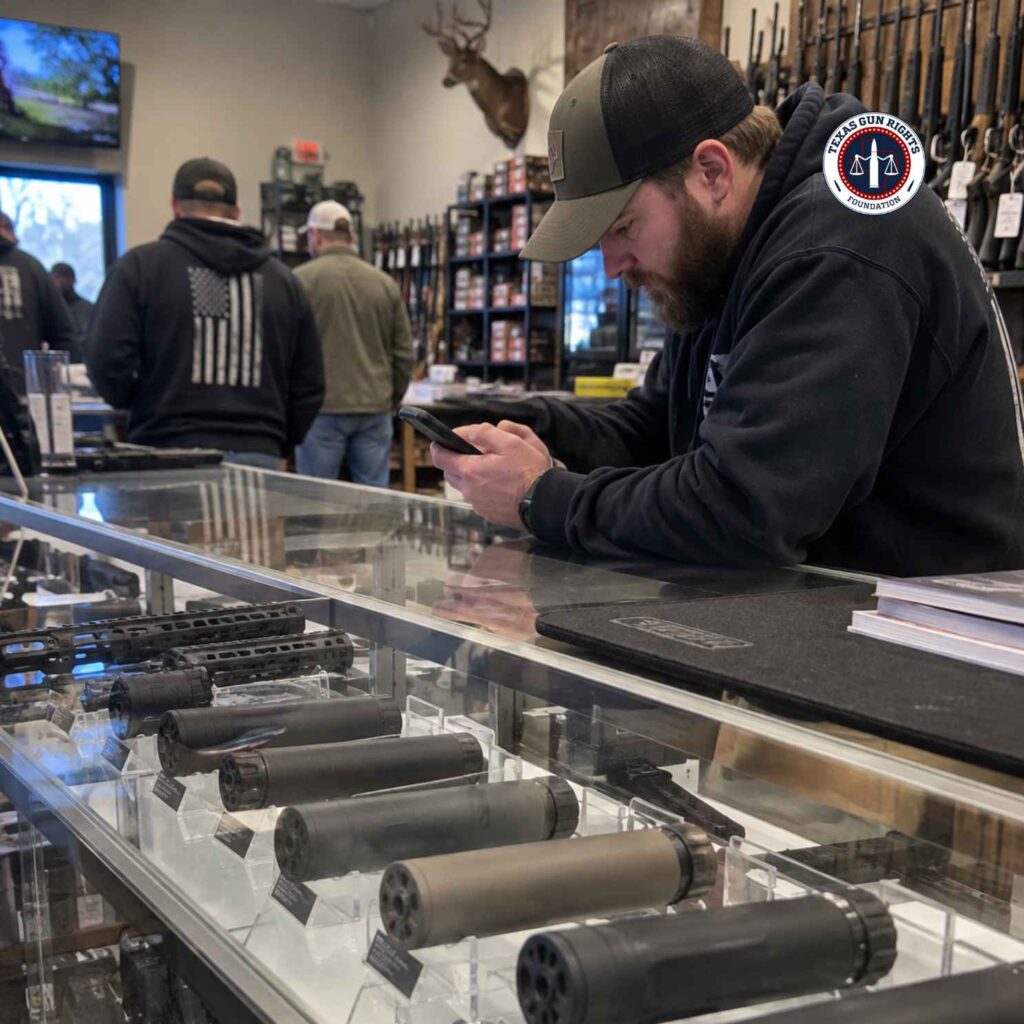
The federal government is reportedly standing down from an appeal of a Texas ruling that blocked major National Firearms Act requirements for suppressors and other untaxed firearms. The decision does not remove suppressors from the NFA nationwide—but it could reshape the legal fight over whether they belong there at all.
A major federal court victory against the National Firearms Act appears poised to stand without an appeal from the Justice Department.
President Donald Trump has directed the Department of Justice not to appeal the August ruling in Silencer Shop Foundation v. ATF, according to CBS News. A DOJ official told the outlet that the Department intends to notify Congress that it will not challenge the decision.
If the administration follows through, it would leave intact a permanent injunction issued by U.S. District Judge James Wesley Hendrix of the Northern District of Texas blocking enforcement of major NFA registration, application, and approval requirements against the covered plaintiffs, members, and customers.
That is a substantial development.
But it is not the same thing as a nationwide judicial ruling removing suppressors from the NFA.
And for the larger constitutional fight, that distinction may be just as important as the victory itself.
The NFA’s Taxing-Power Foundation Just Cracked
The case began with a simple constitutional problem created by Congress itself.
When the National Firearms Act was enacted in 1934, Congress structured it as a tax law. The registration, application, recordkeeping, and approval requirements surrounding suppressors, short-barreled rifles, short-barreled shotguns, and other regulated firearms existed to support collection of federal taxes.
That changed when the One Big Beautiful Bill Act reduced the federal making and transfer tax on suppressors, short-barreled rifles, short-barreled shotguns, and “any other weapons” to $0, effective January 1, 2026.
Congress left most of the regulatory machinery in place.
Judge Hendrix concluded in his August 5 opinion that the government could no longer rely on Congress’s taxing power to support regulations tied to a tax that produces no revenue.
The court held that the challenged provisions exceed Congress’s enumerated powers as applied to the now-untaxed firearms.
That includes major provisions governing registration, applications to make and transfer firearms, and criminal penalties tied to failing to comply with those requirements.
The court then permanently barred ATF, DOJ, and their officials—including successors in office—from enforcing the challenged provisions against the covered plaintiffs and, where applicable, their current and future members and customers.
The temporary seven-day stay expired August 13, putting the injunction into effect.
“This ruling exposed a structural weakness in the NFA that has been hiding in plain sight for decades,” said Texas Gun Rights Foundation President Chris McNutt. “The federal government defended this regulatory system as part of a tax. Once that tax became zero, a federal court concluded that the government could not keep the burdensome registration scheme while pretending the constitutional justification for it was still intact.”
No Appeal Could Preserve the Win—but Limit the Precedent
The reported decision not to appeal creates an unusual legal tradeoff.
If DOJ allows the October 5 appeal deadline to pass, Judge Hendrix’s judgment remains binding on the federal defendants with respect to the parties protected by the injunction.
That gives those plaintiffs real, enforceable relief.
But because the government would not take the case to the Fifth Circuit, there would be no appellate decision adopting Judge Hendrix’s reasoning as binding precedent throughout Texas, Louisiana, and Mississippi.
That matters for the larger legal campaign.
A district court opinion can be persuasive to other judges, but it does not bind other federal district courts or courts of appeals. Another court confronting the same NFA argument could agree with Hendrix—or reject his reasoning.
That means the fight over the NFA’s zero-tax structure may increasingly move through other cases and other jurisdictions.
The American Suppressor Association’s current case status notes that no notice of appeal has been filed and identifies October 5 as the government’s appeal deadline. It also notes that reports indicate DOJ has chosen not to appeal, while the Department has not yet formalized that position on the court record.
For now, the Texas judgment stands.
It just does not stand for everyone.
This Does Not Yet Remove Suppressors From the NFA
That limitation is critical.
The court did not issue a universal nationwide injunction.
Its order protects the named plaintiffs and, where applicable, their agencies, political subdivisions, organizational members, commercial members, and customers—including current and future members and customers.
The court expressly declined to extend relief to everyone in the country.
Suppressors also remain listed as “firearms” under the current text of the National Firearms Act in 26 U.S.C. § 5845.
They remain firearms under the separate Gun Control Act as well. Federal law continues to define a firearm to include “any firearm muffler or firearm silencer” in 18 U.S.C. § 921.
That means the Texas ruling should not be reduced to “suppressors are federally unregulated.”
They are not.
For covered suppressor transactions, the injunction attacks the NFA registration and approval structure. It does not erase the Gun Control Act, prohibited-person laws, ordinary federal firearms-dealer requirements, or applicable state law.
Machine guns and destructive devices are also in a different position because Congress retained the $200 making and transfer taxes on those categories.
The Court Never Reached the Second Amendment
There is another major limitation—and potentially another major opportunity for future litigation.
Judge Hendrix did not hold that suppressor regulation violates the Second Amendment.
The plaintiffs raised Second Amendment claims, but the court concluded that it did not need to reach them after deciding the case under Article I.
That leaves several constitutional questions unresolved.
Among them: whether suppressors are protected “Arms” or components of protected arms for Second Amendment purposes, what historical tradition could support imposing special federal registration on them, and whether the government can subject commonly possessed firearm accessories to a regulatory system originally designed to suppress ownership through taxation.
Those questions remain available for future cases.
The Fifth Circuit has already confronted one suppressor-related Second Amendment challenge in United States v. Peterson. In that case, the court declined to invalidate the NFA on the record before it, while expressly stating that its ruling did not foreclose another litigant from successfully challenging the statute’s requirements.
That means Silencer Shop Foundation does something important without resolving everything.
It demonstrates that major portions of the federal suppressor-registration regime can fail on constitutional grounds before a court even reaches the Second Amendment.
What This Means for the Larger Suppressor Fight
The larger fight to remove suppressors from the NFA now has several distinct paths.
First, the Texas injunction provides a functioning real-world example of suppressor transactions occurring without the traditional NFA registration process for people and transactions protected by the order.
That matters because it separates two questions that were previously treated as one: whether suppressors can remain subject to ordinary federal firearms law and whether they also require the extraordinary registration machinery of the NFA.
Second, the ruling attacks the NFA at its constitutional foundation.
For nearly a century, the federal government defended the Act as a taxation system. Judge Hendrix concluded that once Congress eliminated the relevant tax, the associated regulations could no longer survive on that constitutional theory.
Third, because the ruling is limited rather than nationwide, additional litigation can still test the same theory elsewhere.
Those cases could produce agreement among federal courts, disagreement among circuits, or eventually appellate precedent addressing issues the Texas district court alone cannot settle nationwide.
And fourth, the Second Amendment question remains open.
For suppressor deregulation litigation, that means the August victory is not necessarily the end of the constitutional argument. It may instead remove one layer of the NFA while leaving courts to confront the deeper question of whether the federal government can continue treating suppressors as specially restricted arms or firearm components at all.
“Getting rid of a $200 tax was never the whole issue,” McNutt said. “The larger constitutional problem is forcing Americans through a federal registry and permission system before they can acquire ordinary firearms technology. This ruling shows that once the government’s taxing rationale disappears, the rest of that structure becomes much harder to defend.”
The reported decision not to appeal therefore matters for more than the people immediately protected by the injunction.
It leaves a federal judgment in place declaring major NFA provisions unconstitutional as applied to untaxed firearms. It allows the practical effects of that judgment to continue. And it gives future litigants a detailed constitutional roadmap for attacking the same registration structure.
But it does not mean the NFA has disappeared, that every American is covered by the injunction, or that the Supreme Court has settled the status of suppressors.
The next phase is likely to be fought over the scope of this injunction, similar challenges in other courts, the remaining Gun Control Act restrictions, and eventually the unresolved Second Amendment question.
For nearly 90 years, suppressor owners faced the NFA as a single, largely intact federal system.
That system now has a significant constitutional fracture running through it.
Support the Texas Gun Rights Foundation’s work advancing Second Amendment litigation, legal research, and constitutional education.