
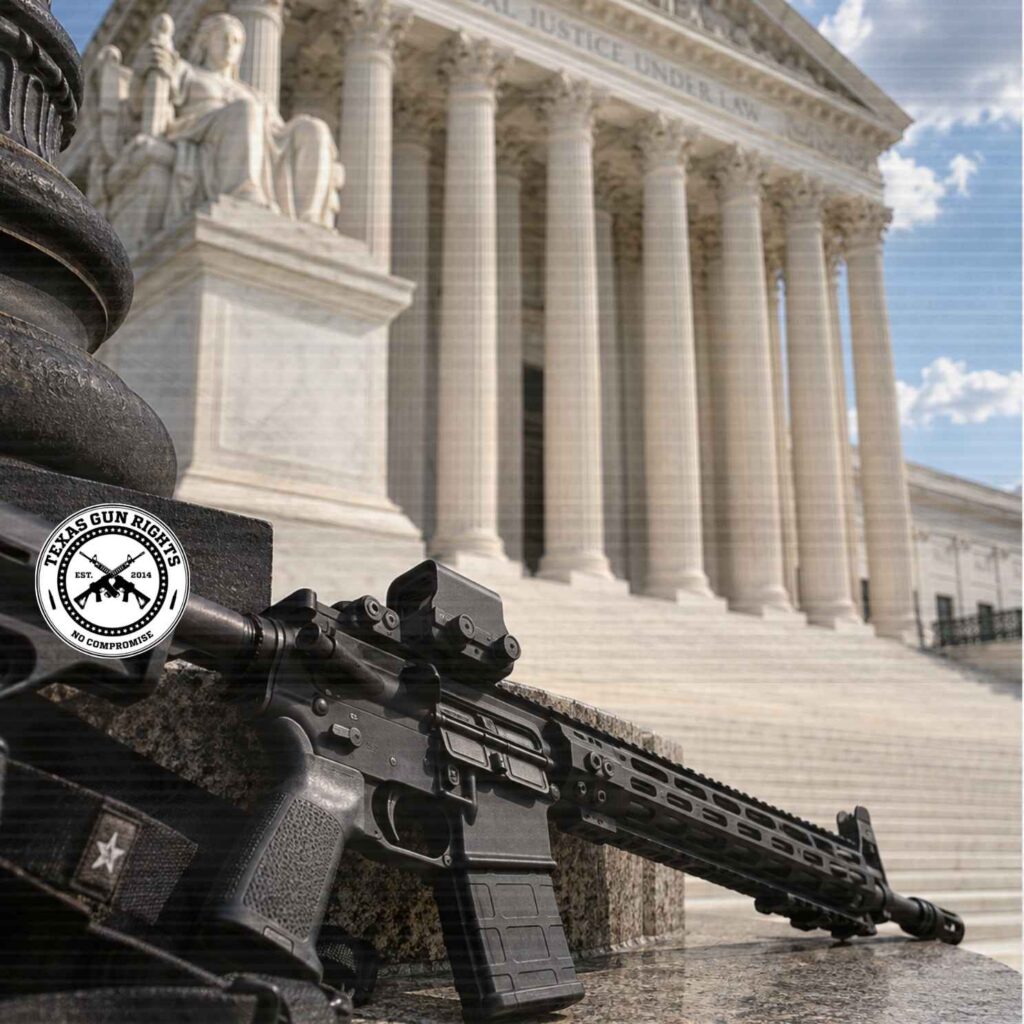
Texas Gun Rights and the National Association for Gun Rights are asking the U.S. Supreme Court for more than another Second Amendment victory.
They want a ruling lower courts cannot evade.
The Supreme Court granted review June 30 in Viramontes v. Cook County and Grant v. Higgins, agreeing to decide whether the Second and Fourteenth Amendments protect the right to possess AR-15-platform and similar semiautomatic rifles.
On September 3, Texas Gun Rights and NAGR filed a merits-stage amicus brief supporting the challengers.
The brief argues that government cannot evade the Second Amendment by banning the components of protected firearms, that the AR-15’s suitability for militia purposes strengthens its constitutional protection, and that the Supreme Court must finally confront lower courts that continue finding ways around its Second Amendment precedents.
“Anti-gun politicians shouldn’t be allowed to do an end-run around the Second Amendment by banning the magazines and components that make America’s most popular rifles function,” said Chris McNutt, President of Texas Gun Rights.
“The AR-15 is exactly the kind of commonly owned firearm the Second Amendment protects, and we’re asking the Supreme Court to make that unmistakably clear.”
You Can’t Ban the Rifle by Banning Its Parts
If the government cannot constitutionally ban a protected rifle outright, can it accomplish the same thing by banning the magazine or components that allow it to function as designed?
Texas Gun Rights and NAGR argue the answer must be no.
The restrictions at issue target semiautomatic rifles while also regulating magazine capacity and, in some cases, components from which prohibited firearms can be assembled.
The brief argues that protecting an AR-15 in theory while allowing politicians to prohibit its standard components would simply create another path to banning the rifle in practice.
And these magazines are anything but unusual.
An NSSF study of detachable magazines supplied to the commercial market from 1990 through 2021 estimated that roughly 963 million magazines entered the market during that period. About 717 million — 74 percent — had capacities exceeding ten rounds.
These are standard components used with firearms owned by millions of Americans.
Government should not be allowed to accomplish indirectly what the Constitution forbids it from doing directly.
Military Utility Strengthens the Second Amendment Case
The brief also attacks a theory courts have used to justify bans on so-called “assault weapons.”
Some lower courts have treated the military usefulness of rifles like the AR-15 as a reason those firearms should receive less constitutional protection.
Texas Gun Rights and NAGR argue that turns the Second Amendment on its head.
The Amendment itself begins with the importance of a “well regulated Militia” to “the security of a free State.”
The brief argues that the Founding generation understood an armed citizenry as a safeguard against both private violence and government tyranny.
Under that understanding, an arm’s suitability for militia service strengthens its connection to the Second Amendment.
It does not exclude that arm from protection.
Otherwise, the firearms most closely tied to one of the Second Amendment’s expressly stated purposes become the easiest firearms for politicians to ban.
TXGR to Supreme Court: Write a Rule Lower Courts Cannot Evade
But the most distinctive part of the brief goes beyond whether AR-15s are protected.
Texas Gun Rights and NAGR are asking the Supreme Court to write its decision so clearly that lower courts cannot simply invent the next workaround.
The brief urges the Justices to establish clear rules and expressly identify conflicting lower-court precedents that can no longer stand.
Its message is blunt:
“Standards invite relitigation; named abrogation ends it.”
The concern is not hypothetical.
Despite Heller, McDonald, and Bruen, federal courts have continued developing new theories to uphold restrictions on commonly owned rifles and magazines.
But clear rules can produce different results.
On July 17, the en banc Third Circuit ruled that New Jersey’s restrictions on semiautomatic rifles and magazines holding more than ten rounds violate the Second Amendment.
Texas Gun Rights and NAGR argue the Supreme Court should leave no doubt about the rule nationwide.
If Lower Courts Resist, Enforce the Ruling
The brief also tells the Supreme Court what should happen if lower courts refuse to follow that rule.
Reverse them quickly.
Texas Gun Rights and NAGR point to summary reversals and other supervisory tools the Court has used to enforce constitutional rights without waiting years for another case to work its way through the courts.
The filing is particularly critical of what happened in Duncan v. Bonta, the challenge to California’s magazine ban.
The Supreme Court already sent Duncan back to the Ninth Circuit following Bruen. The Ninth Circuit later upheld the restriction again using a theory that treats magazines as accessories or “accoutrements” rather than protected arms.
The brief argues that sending cases through the same cycle again is not meaningful Supreme Court supervision.
If lower courts try to preserve gun bans by changing the label — from rifles to “features,” magazines, accessories, licensing, or something else — Texas Gun Rights and NAGR want the Supreme Court to enforce its ruling rather than force gun owners through another decade of litigation.
That is what makes Viramontes and Grant about more than two gun-control laws.
The Court now has an opportunity to decide whether Americans have a constitutional right to own AR-15s and similar semiautomatic rifles.
But what happens afterward matters just as much.
If lower courts can resist Supreme Court precedent long enough to make it appear “unworkable,” the brief warns that a constitutional rule could effectively be “repealed from below by sustained noncompliance.”
That cannot be the standard for the Second Amendment.
The Second Amendment protects commonly owned semiautomatic rifles like the AR-15. Government should not be permitted to destroy that protection indirectly — and lower courts should not be permitted to rewrite it away.
Chip in today to help Texas Gun Rights keep fighting for the Second Amendment.