A federal judge in Fort Worth has ruled that key portions of ATF’s 2022 “Frame or Receiver” Rule violate both the Second Amendment and the Fifth Amendment.
The ATF just suffered another major defeat in a Texas federal court.
On August 17, Chief U.S. District Judge Reed O’Connor ruled in Defense Distributed v. Blanche that two key provisions of ATF’s 2022 “Frame or Receiver” Rule are unconstitutional as applied to Defense Distributed, the Second Amendment Foundation, and SAF’s current and future members.
The ruling is significant for gun owners because O’Connor concluded that the Second Amendment protects conduct involving the personal manufacture and repair of firearms.
And ATF lost on due process grounds, too.
ATF Tried to Move the Line
The federal Gun Control Act defines a “firearm” to include a weapon that will, is designed to, or may readily be converted to fire a projectile, as well as the frame or receiver of such a weapon.
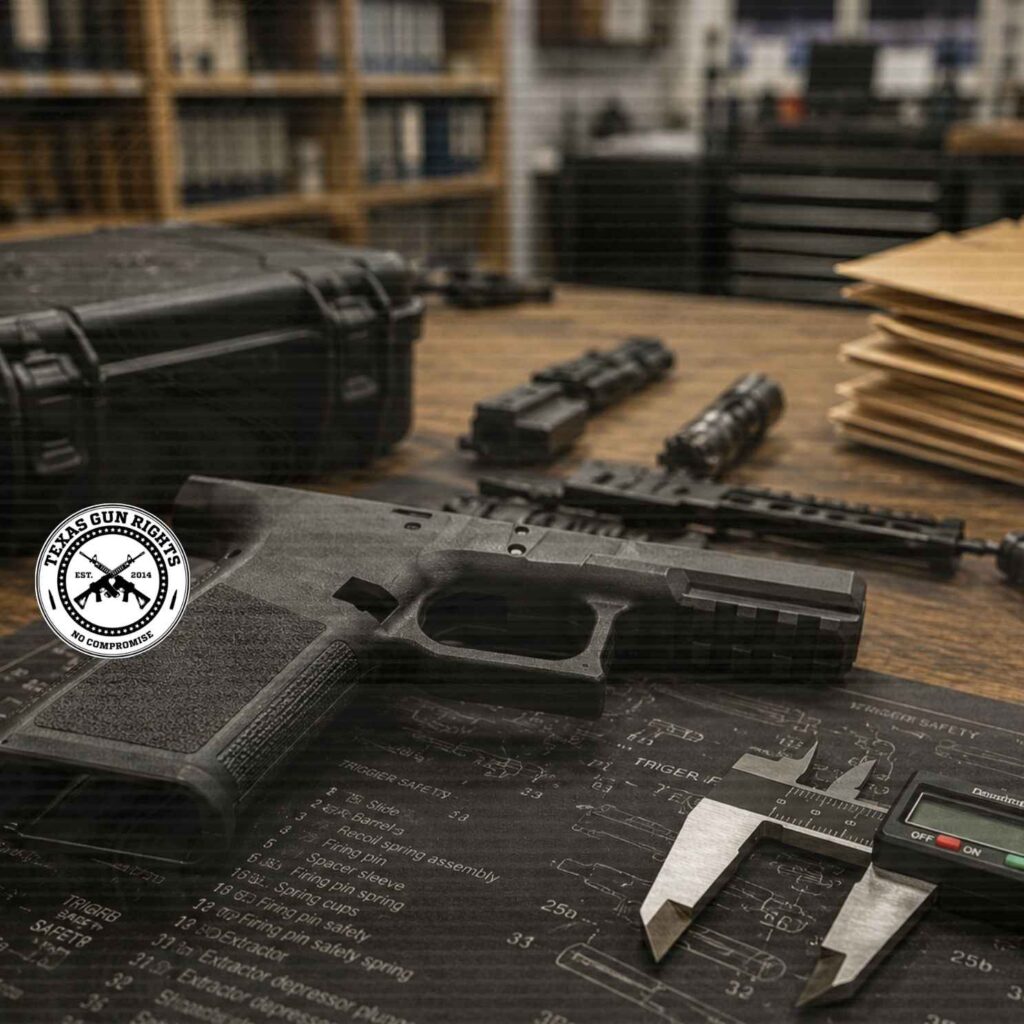
In 2022, ATF expanded its regulations to cover certain partially complete, disassembled, or nonfunctional frames and receivers, along with some weapon-parts kits.
The agency’s rule allowed regulators to consider factors such as time, ease, expertise, equipment, expense, and parts availability when deciding whether an unfinished item could “readily” become a regulated firearm component. ATF could also consider associated jigs, templates, tools, instructions, and marketing materials.
That created the central problem in this case:
At what point does unfinished metal or polymer legally become a federally regulated firearm?
When getting that answer wrong can trigger federal criminal penalties, the line matters.
Supreme Court Left the Constitutional Fight Open
The U.S. Supreme Court considered the same rule in Bondi v. VanDerStok in 2025.
There, the Court rejected a facial statutory challenge and held that the Gun Control Act can reach at least some weapon-parts kits and partially complete frames or receivers.
But the Court did not decide the Second Amendment and due process claims O’Connor addressed here.
Those constitutional claims survived.
And this time, ATF lost.
Court: Personal Gunsmithing Is Protected
O’Connor concluded that making and repairing personal firearms falls within conduct protected by the Second Amendment.
That forced the government to show its regulation was consistent with the Nation’s historical tradition of firearm regulation.
The government pointed to historical barrel-inspection, proof-marking, and gunpowder laws.
The court rejected those comparisons, finding that they dealt largely with product safety and explosive storage rather than restrictions on Americans making their own firearms.
O’Connor wrote that the Final Rule “contradicts the actual historical tradition of personal gunsmithing,” noting the long American history of citizens building and repairing their own arms.
That is a significant Second Amendment holding.
Anti-gun politicians may brand privately made firearms as some modern “ghost gun” loophole, but Americans were making and repairing their own firearms long before the ATF existed.
ATF’s Rule Was Too Vague
The court separately ruled that the challenged provisions violate the Fifth Amendment’s Due Process Clause.
O’Connor found that ATF’s use of terms such as “readily” and “clearly identifiable,” combined with its open-ended list of factors and surrounding materials, failed to give ordinary people adequate notice of where the legal line was drawn.
Americans should not have to guess whether an unfinished object has suddenly become a federally regulated firearm — especially when guessing wrong can carry criminal consequences.
The Victory Has Limits
Gun owners should also understand exactly what the court ordered.
O’Connor declared 27 C.F.R. §§ 478.11 and 478.12(c) unconstitutional under the Second Amendment and void for vagueness under the Fifth Amendment as applied to Defense Distributed, SAF, and SAF’s current and future members.
But the permanent injunction is narrower.
It specifically blocks enforcement against those parties and members with respect to Defense Distributed’s M1911 80% Frames and G80 Build Kit, Unfinished Receiver, and Grip Module.
So this is not a nationwide repeal of the entire Frame or Receiver Rule for every American and every unfinished firearm product.
It also does not erase other applicable federal, state, or local firearms laws.
Another Blow to ATF Gun Control
The federal government can still appeal the decision to the Fifth Circuit, meaning this fight may continue.
But the ruling establishes an important principle: federal bureaucrats cannot simply blur the definition of a firearm and force gun owners to guess where criminal liability begins.
More importantly, the court recognized that America’s tradition of personally making and repairing firearms is not outside the Second Amendment.
Texas Gun Rights will continue fighting federal gun-control schemes that turn constitutionally protected activity into a bureaucratic permission slip.
Chip in today to help Texas Gun Rights keep fighting unconstitutional gun control and defending the Second Amendment without compromise.