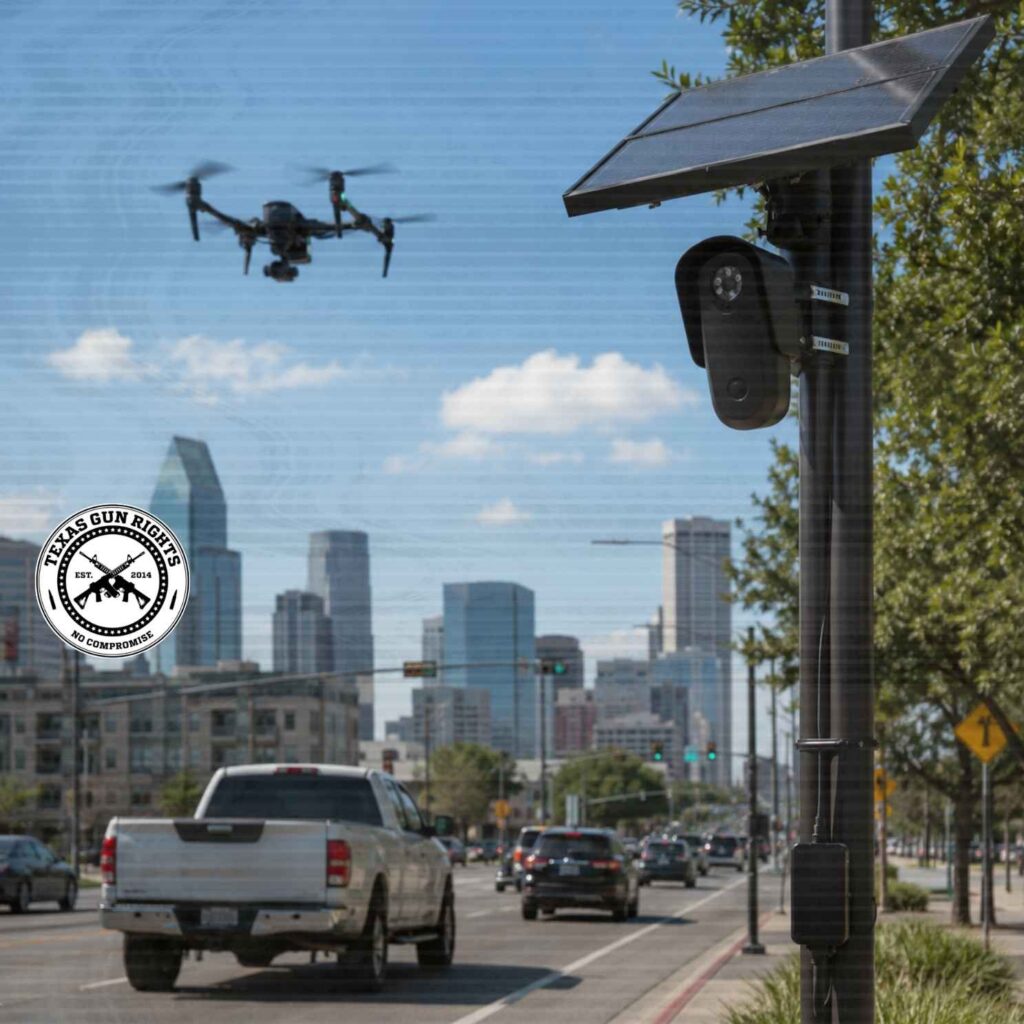
Fort Worth has connected automated police drones to its license-plate readers and real-time crime center. Texas Gun Rights warns that today’s limited program could become tomorrow’s warrantless tracking machine.
Government always asks gun owners to judge new powers by the promises of the politicians creating them.
History tells us to judge those powers by what the worst future administration could do with them.
That warning now applies to Flock Safety’s expanding surveillance network.
Texas Gun Rights recently exposed how Flock license-plate readers can record where Texans travel, identify visits to gun stores and shooting ranges, and create a backdoor method of cataloging gun owners through their lawful movements.
Now that surveillance system is leaving the roadside and taking flight.
Fort Worth Connects Drones to the Flock Network
The Fort Worth Police Department launched a Drone as First Responder program with Flock Safety in June.
Under the program, drones can launch from automated docks following qualifying 911 calls, license-plate-reader alerts, or gunshot-detection alerts. They can reach nearby incidents within minutes and transmit live video to officers, dispatchers, and the department’s real-time crime center.
This is not a stand-alone police drone launched by an officer already at a scene.
It is part of an integrated network connecting cameras, vehicle information, alerts, dispatch systems, and live aerial surveillance.
Flock markets its Alpha drone as capable of reading license plates from as far as 2,000 feet away. The system also offers thermal imaging, low-light capabilities, night vision, zoom, and direct integration with license-plate readers and gunshot-detection systems.
A camera mounted beside a road records vehicles passing one fixed location.
A drone can move.
It can be redirected, observe a scene from above, follow activity across a wider area, and send live footage into the same system already collecting license-plate data.
That is a major expansion of surveillance power.
The Real Danger Is Who Controls It Next
Fort Worth and Flock say the drones will only deploy in response to specific incidents rather than conduct general patrols.
They also say each flight will be logged, the camera will face the horizon while traveling, and a public dashboard will provide information about how the drones are used.
Those promises may describe the program today.
They are not permanent legal limits.
Department policies can be rewritten. Vendor practices can change. Data-sharing agreements can expand. A future city council, police chief, prosecutor, or federal partner could inherit the same machinery and use it far more aggressively.
Gun owners have already seen that pattern with ATF.
Federal politicians created supposedly limited powers and regulatory systems. Later administrations stretched those powers, changed definitions, and used agency rules to threaten Americans who had committed no violent crime.
The problem was not only who controlled ATF when the power was created.
The problem was that the machinery existed for a future gun-ban administration to weaponize.
Flock creates the same institutional danger.
“ATF taught gun owners what happens when government builds an enforcement machine and promises it will be used responsibly,” said Chris McNutt, president of Texas Gun Rights. “The politicians change, the mission expands, and yesterday’s narrow power becomes tomorrow’s weapon.”
“Texas must not hand future gun-ban politicians a camera-and-drone dragnet capable of tracking Texans from the highway into the sky and then beg them to show restraint.”
Texas Must Regulate the Entire Surveillance System
Texas law cannot focus only on cameras mounted on poles.
Lawmakers must address the entire integrated surveillance network, including automated drones, aerial plate recognition, thermal observation, retention of video and location data, cross-agency access, and drone launches triggered by automated alerts.
Law enforcement should investigate specific criminal suspects based on probable cause.
It should not build a permanent system capable of following the movements and associations of millions of Texans who have never been accused of a crime.
During the 2025 legislative session, State Rep. Brian Harrison introduced H.B. 961 to restrict automatic license-plate readers, require warrants or court orders in many circumstances, limit data sharing, and require the destruction of unrelated records. The bill died without receiving a vote.
The next proposal must go further.
It must ensure that license-plate readers cannot automatically trigger aerial tracking without adequate legal safeguards. It must limit how long agencies retain drone footage and plate information. And it must stop local, state, and federal agencies from combining separate databases into one warrantless surveillance grid.
Flock’s system may be sold today as a faster way to respond to emergencies.
Texas must write its laws based on what that system could become tomorrow.
SIGN THE PETITION: STOP FLOCK’S BACKDOOR TRACKING OF GUN OWNERS
Chip in today to help Texas Gun Rights stop warrantless surveillance from being weaponized against law-abiding gun owners.